Product Introduction
- Definition: Tadak is a premium iOS/macOS spatial audio white noise application (Category: Lifestyle/Wellness Audio Software) leveraging Apple's PHASE framework for real-time 3D audio rendering.
- Core Value Proposition: Tadak exists to transform passive noise masking into an active, personalized auditory experience. It solves the limitations of traditional loop-based white noise apps by enabling users to design unique, non-repetitive soundscapes positioned dynamically in 3D space, enhancing focus, sleep, and relaxation through customizable immersion.
Main Features
- Spatial Sound Design:
- How it works: Users layer multiple sound sources (e.g., rain, wind, fire) and position them precisely within a 3D sphere via drag-and-drop. Apple's PHASE framework calculates real-time audio propagation, adjusting volume, frequency response, and spatial cues based on virtual distance and direction relative to the listener. This creates a realistic, head-tracked (where supported) sound environment.
- Fractal Algorithm & Non-Repetitive Playback:
- How it works: Tadak employs a proprietary fractal-based algorithm to generate subtle, continuous variations in each sound layer. This disrupts fixed audio loops, preventing auditory fatigue and creating an organic, evolving soundscape that feels natural and never mechanically repetitive.
- White Noise Color Equalizer:
- How it works: Beyond simple volume, users can adjust the spectral characteristics ("color") of each white noise layer. This equalizer reshapes the frequency profile (e.g., emphasizing lower frequencies for "brown noise" warmth or higher frequencies for "pink noise" balance), tailoring the sonic texture to individual preference or specific masking needs.
- LP Player Customization:
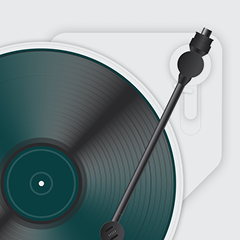
- How it works: The app presents the user's custom sound mix as a virtual vinyl record. Users can upload personal photos for custom album art, select LP disc colors, and position the tonearm. Playback includes simulated vinyl crackle, adding nostalgic ambiance to the white noise experience.
- Preset Library & Customization:
- How it works: Offers curated multi-layered presets (e.g., "Deep Ocean," "Autumn Night," "White Christmas") with sounds pre-positioned in 3D space. Users can use these instantly or deconstruct and modify them as a starting point for their own soundscape creation.
- Background & System Integration:
- How it works: Provides uninterrupted audio playback in the background. Integrates with iOS features: playback controls appear on the Lock Screen, status is visible in Dynamic Island, and supports widgets for quick access.
Problems Solved
- Pain Point: Repetitive, monotonous sound loops in standard white noise apps cause listener fatigue and reduce effectiveness for concentration or sleep.
- Target Audience: Students, remote workers, programmers, individuals with ADHD or tinnitus, light sleepers.
- Use Case: A student needing sustained focus for hours uses Tadak's non-repetitive fractal algorithm to maintain a calming background soundscape without distraction.
- Pain Point: Generic, one-size-fits-all white noise fails to address individual sensitivity to sound types or spatial perception.
- Target Audience: Audiophiles, meditation practitioners, people sensitive to specific frequencies, users seeking deep immersion.
- Use Case: An individual creates a personalized "Focus Cave" soundscape by layering distant rain (placed behind), soft brown noise (centered, EQ'd for warmth), and faint forest birds (placed left), all at precise volumes.
- Pain Point: Lack of spatial depth in audio reduces realism and immersion, making soundscapes feel artificial.
- Target Audience: Gamers, VR users, anyone seeking a truly enveloping auditory experience for relaxation or escapism.
- Use Case: Someone simulating a "Quiet Night Flight" places distant engine rumble below and behind, subtle cabin air flow overhead, and muffled chatter far to the right, creating a convincing spatial atmosphere.
Unique Advantages
- Differentiation: Unlike static competitors (e.g., simple loop players like "White Noise Lite" or "Relax Melodies"), Tadak offers true 3D spatial audio placement via PHASE, non-repetitive sound generation via fractals, and deep sound color customization, moving beyond fixed mixes and loops.
- Key Innovation: The integration of Apple's PHASE framework for computationally efficient, high-fidelity spatial audio on Apple devices, combined with the fractal variation algorithm, creates a uniquely dynamic and customizable sound environment unmatched by traditional white noise apps. The LP metaphor adds a distinctive creative and nostalgic layer.
Frequently Asked Questions (FAQ)
- Does Tadak collect any user data?
No, Tadak's developer explicitly states in the App Privacy details that the app does not collect any user data, ensuring privacy for all soundscape creation and listening activities. - What Apple devices and OS versions support Tadak's spatial audio?
Tadak requires iOS 18.6/iPadOS 18.6 or later and is compatible with iPhone, iPad, Mac, Apple Vision Pro, Apple Watch, and Apple TV, leveraging Apple's PHASE framework for spatial audio where hardware supports it. - How does Tadak prevent the repetitive sound loops common in other white noise apps?
Tadak uses a proprietary fractal-based algorithm that continuously introduces subtle, natural variations into each sound layer, eliminating mechanical looping and creating an organic, evolving audio experience that reduces listener fatigue. - Can I use Tadak to fall asleep or while using other apps?
Yes, Tadak supports seamless background audio playback and includes a sleep timer feature, allowing it to play continuously while you sleep or while using other applications on your device. - How does Tadak compare to other spatial audio apps like Endel?
While both use spatial audio, Tadak focuses on user-customizable soundscape creation with manual 3D placement and sound color EQ, whereas Endel typically generates adaptive soundscapes algorithmically based on biometrics or time. Tadak offers more hands-on control and the unique LP customization feature.