Product Introduction
Definition
The Email API Benchmarks by Knock is a real-time observability dashboard and comparative analysis tool designed to measure the performance, reliability, and uptime of leading transactional email service providers. Technically classified as a public data-transparency initiative, it leverages proprietary data from billions of production API requests routed through the Knock notification infrastructure to provide empirical metrics on third-party email delivery services.
Core Value Proposition
The platform exists to replace marketing-driven selection processes with data-driven decision-making. By surfacing real-world performance data—such as median response times and 5xx error rates—Knock empowers developers and engineering leaders to evaluate email providers like SendGrid, Amazon SES, and Postmark based on actual system performance rather than theoretical service level agreements (SLAs). Key keywords include "Email API performance," "transactional email benchmarks," "email provider reliability," and "real-time API monitoring."
Main Features
Real-Time Performance Dashboard
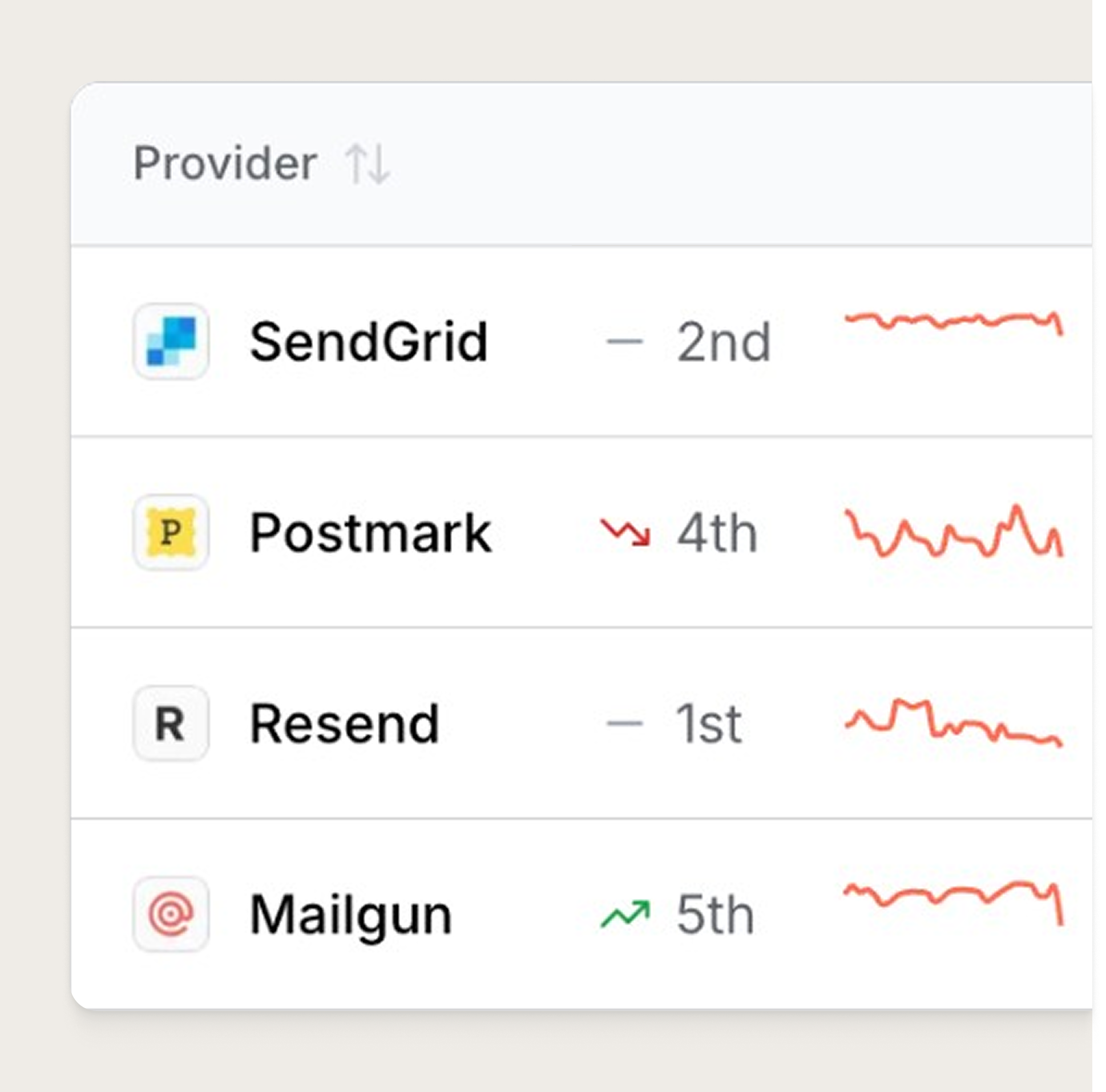
The core feature is a live-updated table that ranks providers across critical technical vectors. Data is updated daily using a trailing 90-day window to smooth out anomalies while capturing current trends. Metrics include Median Response Time (p50), Error Rate (percentage of 5xx status codes), and Message Volume bands (ranging from <1M to 500M+). This allows users to filter and sort providers based on the specific needs of their application stack.
Head-to-Head Provider Comparison Tool
This interactive module allows users to select any two providers (e.g., Amazon SES vs. Resend) for a direct side-by-side technical audit. The comparison highlights differences in latency, error frequency, and growth trajectories. It also includes pricing curve modeling, which selects the lowest-cost plan for specific volumes, providing a "price floor" estimate that factors in overage rates and included email allowances.
Advanced Data Methodology and Analytics
The benchmarks are powered by a high-performance analytics backend using ClickHouse. Knock utilizes the quantileExact function to ensure that response time percentiles (p50, p90, p95, p99) are mathematically precise rather than sampled approximations. The measurement logic accounts for HTTP connection pooling time and network latency, and includes the total duration of automatic retries, providing a comprehensive view of the "request-to-acceptance" lifecycle.
Status Page and Incident Correlation
On individual provider detail pages, Knock integrates public status page data via RSS or API. This feature overlays reported incidents onto the measured performance data. This correlation serves as a transparency signal, helping users determine if a provider’s internal monitoring and public communication align with the performance degradations observed in production environments.
Problems Solved
Pain Point: Information Asymmetry in Email Infrastructure
Choosing an email provider often relies on outdated blog posts or biased marketing materials. Developers frequently encounter "black box" performance where a provider claims high availability but suffers from frequent intermittent 5xx errors or high latency during peak hours. Knock solves this by providing "Real-world Performance Data" that reflects the actual experience of a production notification engine.
Target Audience
- Software Engineers and DevOps: Seeking the lowest latency APIs to ensure application responsiveness.
- CTOs and Engineering Managers: Evaluating vendor reliability and cost-efficiency for large-scale migrations.
- Product Managers: Ensuring that time-sensitive notifications (e.g., OTPs, password resets) meet delivery speed requirements.
- Growth Marketers: Analyzing provider popularity and "Channel Growth" to identify emerging, developer-friendly platforms.
Use Cases
- Infrastructure Migration: Using the comparison tool to justify moving from a high-latency legacy provider to a faster, modern API like Postmark or Resend.
- New Product Launch: Selecting a provider with a robust free tier and low error rate (e.g., Amazon SES or Mailgun) to minimize initial overhead.
- Redundancy Planning: Identifying secondary providers with high reliability to act as failovers in a multi-provider notification workflow.
Unique Advantages
Differentiation: Production-Scale Benchmarking
Unlike traditional "synthetic" load tests that run in isolated environments, these benchmarks are derived from "billions of messages" sent by actual applications. This reflects the impact of system congestion, ISP throttling, and public incidents that synthetic tests often miss.
Key Innovation: The Orchestration Layer Advantage
Because Knock operates as an agnostic orchestration layer, it sits in a unique position to collect "unbiased, cross-provider telemetry." The data is not self-reported by the providers themselves, but observed by a neutral third party. Additionally, the inclusion of "Channel Growth" metrics provides a unique signal of developer sentiment and market adoption trends that are typically unavailable in standard performance monitors.
Frequently Asked Questions (FAQ)
Which email provider has the fastest API response time?
According to the latest 90-day data, SendGrid currently leads the industry with a median (p50) response time of 22ms. Postmark and Resend follow closely, with response times of 33ms and 79ms respectively. These metrics include HTTP connection pooling and network latency, representing the total time from request to message acceptance.
Which email API is the most reliable for high-volume sending?
Amazon SES, Mailgun, and Mailjet currently maintain the highest reliability ratings with a 0.00% 5xx error rate. Reliability is measured by the ratio of server-side errors (500, 502, 503) to total requests. For high-volume senders, Amazon SES and Mailgun also offer the most significant message capacity, handling hundreds of millions of requests within the tracked period.
How does Knock determine the growth of email providers?
Growth is calculated based on "Channel Growth" within the Knock platform. This tracks the number of new API connections (channels) created for a specific provider over a 90-day window. The trend is determined by comparing the first 45 days to the second 45 days, identifying which providers are gaining traction among developers and modern engineering teams.