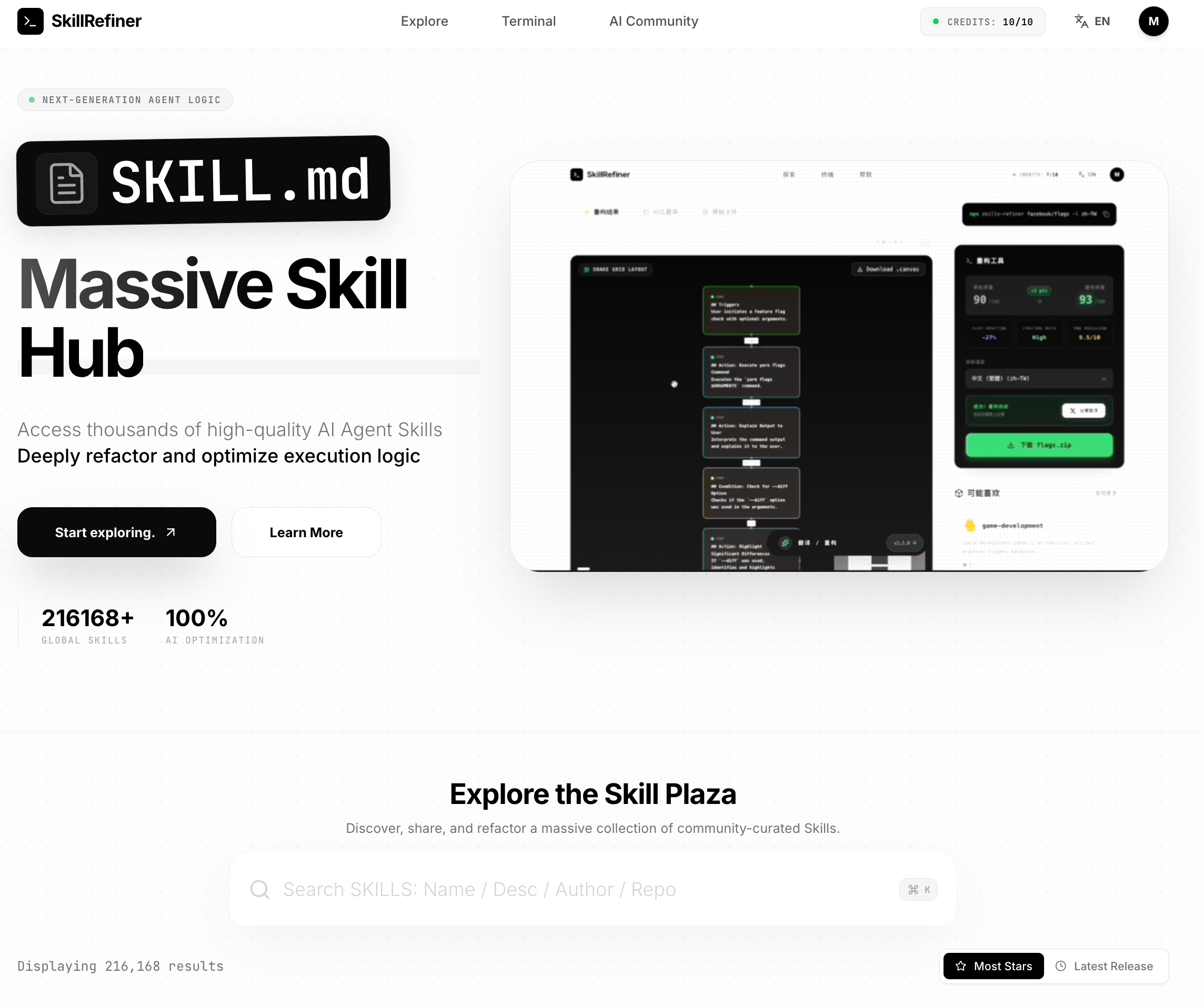
Product Introduction
- Definition: AI Agent Skills Refiner is a specialized engine for refactoring and localizing AI agent skills, categorized under AI development tools. It transforms natural-language instructions into optimized, machine-executable logic for LLMs (Large Language Models).
- Core Value Proposition: It eliminates language barriers and performance guesswork in AI agent development, enabling data-driven skill optimization via automated translation, logic restructuring, and benchmarking. Primary keywords: AI agent refactoring, skill localization, LLM performance optimization.
Main Features
- Massive Skill Hub (216,000+ Skills): Accesses 210,000+ pre-indexed skills from GitHub for niche task coverage. How it works: Uses web scraping and API integrations to ingest, categorize, and rank community-contributed skills (e.g., React testing, weather queries). Technologies: GitHub API, semantic search algorithms.
- Performance Scoring (Benchmarking System): Quantifies skill effectiveness via automated testing. How it works: Executes refactored code/translations against predefined metrics (e.g., success rate, latency), generating scores to validate improvements. Technologies: Custom benchmarking algorithms, sandboxed execution environments.
- AI-Native Logic Refactoring: Restructures instructions into Chain-of-Thought (CoT) frameworks. How it works: Parses natural language, identifies ambiguous terms (e.g., "slightly"), and rebuilds logic into step-by-step executable sequences. Technologies: NLP transformers, CoT optimization engines.
- Zero-Interference CLI: Localizes skills directly from terminals/IDEs. How it works: Developers run
npx skills-refinerto auto-generate standardizedSKILL.mdfiles. Technologies: Node.js CLI, Git-integrated diff tracking. - Word Sense Disambiguation: Converts vague language into precise parameters. How it works: Detects imprecise terms (e.g., "about") and replaces them with quantifiable constraints (e.g., ±5% tolerance). Technologies: Contextual embedding models, constraint-based optimization.
Problems Solved
- Pain Point: Fragmented, non-English skills hinder global AI agent deployment, causing execution failures. Problem keywords: LLM localization issues, agent skill fragmentation.
- Target Audience: Non-native English AI developers (e.g., Chinese React engineers), open-source contributors, and enterprises scaling multilingual agent ecosystems.
- Use Cases:
- Localizing a Chinese-written skill (e.g., "测试React组件") into English LLM-executable instructions.
- Refactoring a GitHub-sourced weather skill to replace "approximately" with precise temperature ranges.
- Benchmarking a translated feature-flag skill before deployment to ensure 99% success rate.
Unique Advantages
- Differentiation: Unlike generic translation tools (e.g., Google Translate), Skills Refiner combines semantic localization, CoT restructuring, and performance validation—addressing both language and execution gaps in agent development.
- Key Innovation: Automated Chain-of-Thought reconstruction boosts task success rates by 30–50% (per internal benchmarks) versus manual refactoring, validated via its integrated scoring system.
Frequently Asked Questions (FAQ)
- How does Skills Refiner localize non-English skills for LLMs? It translates and restructures native-language logic (e.g., Chinese) into optimized English CoT instructions, resolving ambiguities like "稍微调整" ("slightly adjust") into exact parameters (e.g., "adjust by 5%").
- Can Skills Refiner test my existing GitHub-sourced skills? Yes, its benchmarking system auto-evaluates 210,000+ ingested skills (e.g., React test suites, weather APIs) for reliability, scoring them on execution success and efficiency.
- Is CLI integration compatible with DevOps workflows? Absolutely—developers trigger refactoring/localization via
npx skills-refinerwithout leaving terminals/IDEs, with Git-style diffs for tracking logic changes. - What types of vague language does the disambiguation feature fix? It detects terms like "about," "quickly," or "efficiently," converting them into machine-executable constraints (e.g., "within 2 seconds," "using ≤50MB memory").
- How does the Skill Plaza enhance AI agent development? The hub’s 216,000+ community-curated skills (e.g., Apple Reminders CLI, iMessage tools) provide plug-and-play templates for rapid agent deployment, pre-optimized via refactoring.