
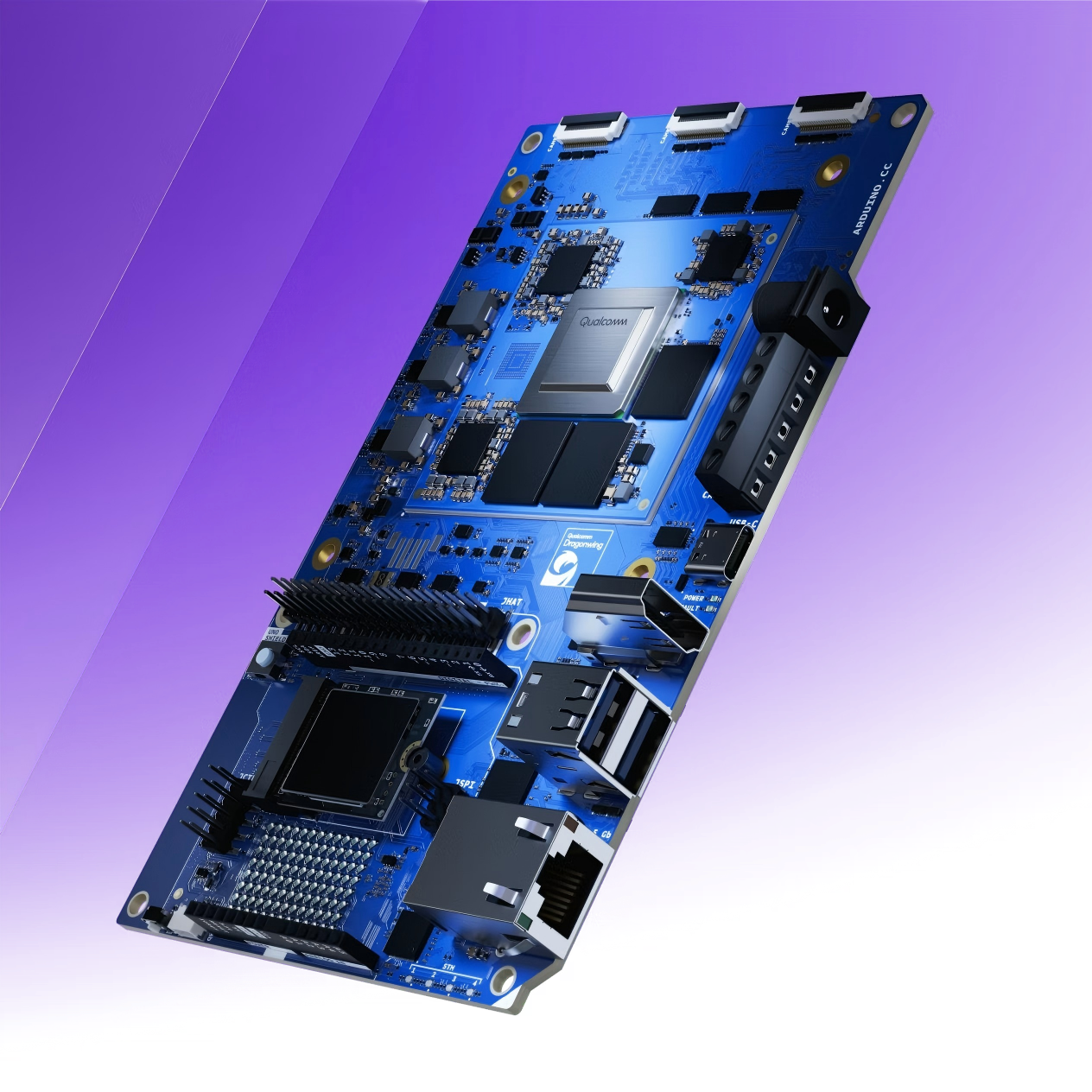
Product Introduction
- Definition: The VENTUNO Q is an industrial-grade single-board computer (SBC) engineered for edge AI and robotics. It integrates a Qualcomm Dragonwing™ IQ8 processor (with a 40 TOPS NPU) and an STM32H5 microcontroller in a unified dual-brain architecture.
- Core Value Proposition: VENTUNO Q eliminates latency and complexity in AI-driven robotics by merging high-performance AI inference (via Snapdragon NPU) with deterministic real-time control (via STM32 MCU), enabling seamless physical-world interactions for industrial automation, robotics, and edge AI deployments.
Main Features
Dual-Brain Architecture:
- How it works: The Qualcomm Dragonwing IQ-8275 (AI Brain) handles neural network inference (vision models, LLMs) using its Hexagon NPU, CPU, and GPU, while the STM32H5F5 MCU (Action Brain) executes sub-millisecond robotics control via CAN-FD, PWM, and GPIO. Both communicate via RPC bridge for synchronized operation.
- Technologies: Snapdragon NPU (40 dense TOPS), Arm Cortex A623 CPU, STM32H5 Cortex-M33 MCU.
Unified Development Environment (Arduino App Lab):
- How it works: A single platform for coding Arduino sketches, Python scripts, and AI models. Supports ROS 2 integration and pre-built "Robotics Bricks" for reusable components like motor control or sensor fusion.
- Technologies: Edge Impulse for model training, Qualcomm AI Hub for optimized libraries, Docker/VS Code compatibility.
Robotics-Ready Hardware:
- How it works: Triple MIPI-CSI ports enable 360° vision systems, while CAN-FD and industrial I/O support deterministic motor control. Includes 16GB LPDDR5 RAM for concurrent AI workloads and M.2 NVMe Gen.4 storage expansion.
- Technologies: 2.5Gb Ethernet, Wi-Fi 6, USB-C DisplayPort Alt Mode, MediaPipe for gesture recognition.
Pre-Optimized AI Models:
- How it works: On-device AI libraries (via Edge Impulse/Qualcomm AI Hub) include Qwen for local LLMs, YOLO-X for object tracking, and Whisper/Melo TTS for offline speech processing—all optimized for the NPU.
- Technologies: Qwen VLM for visual-language tasks, PoseNet for movement analysis.
Problems Solved
- Pain Point: Fragmented edge AI setups requiring separate devices for inference (GPU) and control (MCU), leading to latency, cost, and reliability issues in robotics.
- Target Audience:
- Robotics engineers needing real-time actuation + AI vision.
- Industrial designers building quality-control systems.
- Researchers prototyping offline-capable AI assistants.
- Use Cases:
- Real-time object tracking in automated factories.
- Offline healthcare assistants with speech/gesture interaction.
- ROS 2-based autonomous robots with sub-millisecond motor response.
Unique Advantages
- Differentiation: Unlike Raspberry Pi (AI-only focus) or NVIDIA Jetson (no native MCU), VENTUNO Q’s dual-brain design merges 40 TOPS NPU power with industrial-grade real-time control—enabling closed-loop AI robotics in one board.
- Key Innovation: Hardware-level RPC bridge between NPU and MCU, allowing deterministic sub-millisecond actions triggered by AI decisions without external communication latency.
Frequently Asked Questions (FAQ)
Can VENTUNO Q run without cloud connectivity?
Yes, it operates entirely offline using local LLMs (Qwen), VLMs, and ASR/TTS models—ideal for privacy-sensitive applications like healthcare or secure facilities.How does VENTUNO Q compare to Arduino Portenta or Raspberry Pi 5?
VENTUNO Q outperforms Portenta in AI compute (40 TOPS vs. no dedicated NPU) and surpasses Raspberry Pi 5 with real-time MCU control, CAN-FD, and triple MIPI-CSI for robotics.Is VENTUNO Q compatible with existing Arduino/Raspberry Pi accessories?
Yes, it supports UNO shields via native headers, Raspberry Pi Hats via 40-pin GPIO, and Qwiic/Modulino nodes for solder-free sensor expansion.What AI frameworks are supported for custom model deployment?
Edge Impulse for training, Qualcomm AI Hub for optimization, and frameworks like TensorFlow/PyTorch via Ubuntu/Debian OS.Can I use VENTUNO Q for real-time industrial control systems?
Absolutely. Its STM32H5 MCU delivers sub-millisecond response on CAN-FD/PWM, meeting safety-critical standards for motor control and automation.


