
Product Introduction
- Definition: OrchestraML is a cloud-based, agentic AI platform for Machine Learning (ML) lifecycle automation. It is a specialized AI system that uses a team of eight autonomous software agents to orchestrate the entire workflow from data discovery to model deployment, culminating in the generation of a production-ready ML pipeline.
- Core Value Proposition: OrchestraML exists to democratize machine learning by transforming plain-English prompts into fully operational, production-grade ML models while providing unparalleled human oversight. Its primary function is to automate the complex, multi-step MLOps process—dataset handling, exploratory data analysis (EDA), data cleaning, feature engineering, AutoML model training, and deployment—through a secure, auditable, human-in-the-loop framework.
Main Features
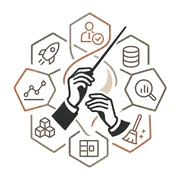
- Multi-Agent Collaboration System: The core of OrchestraML is an orchestrated team of eight specialized AI agents: Orchestrator, Dataset, EDA, Cleaning, Features, Modeling, Evaluation, and Deployment. Each agent is designed for a discrete stage of the ML pipeline, communicating sequentially to execute complex tasks. The Orchestrator agent, powered by Gemini Flash for efficient reasoning, parses the user's goal, plans the pipeline, and detects task types, forming the system's "brain."
- Human-in-the-Loop Checkpoints: The platform enforces strict governance through six mandatory human approval gates. At critical decision points—such as before feature dropping, model selection, or final deployment—the pipeline halts execution. This "Human-in-the-Loop" mechanism ensures the user retains full control, reviewing AI decisions and audit logs before authorizing the next step, preventing unchecked automated errors.
- Smart AutoML with FLAML: OrchestraML integrates FLAML (Fast Library for Automated Machine Learning) as its modeling engine. It features adaptive time budgets, automatically selecting appropriate computational resources and model complexity based on dataset size and characteristics. This avoids a "one-size-fits-all" approach, training efficient models on small datasets and deploying powerful ensemble methods like LightGBM on larger ones to optimize the accuracy-efficiency tradeoff.
- SHAP Explainability and AI Audit Trail: Every decision made by the AI agents is logged with plain-English reasoning in a comprehensive AI Audit Trail. Furthermore, the platform generates SHAP (SHapley Additive exPlanations) analysis for model interpretability. Users receive global feature importance plots, beeswarm plots for feature interaction visualization, and per-prediction explanations, enabling deep insight into the model's decision-making process.
- Automated Bias Detection and EDA: OrchestraML conducts automated bias detection by profiling sensitive demographic columns within the dataset. It flags performance disparities exceeding a 10% threshold between groups before deployment. Concurrently, it performs full Exploratory Data Analysis (EDA), automatically generating and saving distribution charts, correlation heatmaps, class balance visualizations, and outlier boxplots in the final report.
- Ready-to-Run Deployment Package: The platform provides a complete, portable deployment solution. Users can download a ZIP package containing a
model.pklfile,scaler.pkl, apredict.pyscript, arequirements.txtfile, and a step-by-step README. Alternatively, users can deploy a live REST API endpoint instantly for immediate model inference. - AES-256 Encrypted Data Handling: Security is integrated into the pipeline. All uploaded datasets are encrypted using AES-256 encryption. Following the completion of the ML pipeline, the source dataset is securely deleted from OrchestraML's servers, ensuring that only the trained model artifacts and reports are retained, maintaining strict data privacy.
Problems Solved
- Pain Point: The primary pain point solved is the steep technical barrier and time-consuming nature of building production-ready ML models. OrchestraML eliminates the need for deep expertise in data wrangling, feature engineering, algorithm selection, and MLOps deployment, which traditionally requires advanced coding skills and significant manual effort.
- Target Audience: The primary users are tech students seeking to learn and apply ML concepts without boilerplate code, developers who need rapid prototyping for ML-enabled features, and domain experts with valuable data but limited ML engineering resources. It serves anyone requiring "production-grade ML workflows without writing a single line of ML code."
- Use Cases:
- Student Projects & Learning: Tech students can describe a project goal (e.g., "predict housing prices") and instantly receive a full, explainable ML pipeline, learning from the AI audit trail and EDA reports.
- Rapid Prototyping for Startups: Small teams can validate ML hypotheses and generate baseline models in minutes rather than weeks, using the instant deployment API to test functionality.
- Automating Repetitive ML Tasks: Data analysts can automate recurring tasks like customer churn prediction or sales forecasting by providing updated datasets and prompts, leveraging the checkpoint system for quality control.
- Generating Production Baselines: Developers can quickly establish a working ML model baseline for integration, using the downloaded package to run predictions locally or the deployed API for service integration.
Unique Advantages
- Differentiation: Compared to traditional AutoML tools (like H2O or Auto-sklearn) which focus solely on model training, OrchestraML provides a full end-to-end pipeline including data sourcing, cleaning, and deployment. Unlike notebook-based environments (e.g., Jupyter), it adds a governed, agent-driven workflow with mandatory human approval gates. It differs from DIY MLOps platforms (e.g., Kubeflow) by requiring no infrastructure setup or pipeline coding.
- Key Innovation: The key innovation is the agentic, multi-agent architecture combined with a rigid human-in-the-loop checkpoint system. This hybrid approach uniquely balances the speed and consistency of automation with the judgment and oversight of a human expert. The system does not merely suggest steps; it autonomously executes discrete pipeline stages while architecturally pausing for user validation at critical junctures, creating a collaborative AI-human workflow.
Frequently Asked Questions (FAQ)
- How does OrchestraML work? You describe your machine learning goal in plain English. OrchestraML then uses eight specialized AI agents to automatically search for or use your dataset, perform exploratory analysis, clean the data, engineer features, train a model using FLAML AutoML, evaluate it with SHAP explanations and bias checks, and finally deploys it as a downloadable package or live API—all while pausing at six checkpoints for your approval.
- Who is OrchestraML designed for? OrchestraML is built for tech students, developers, and data professionals who need to build production-ready ML models quickly. It is ideal for users who want to leverage machine learning without writing extensive data processing or model training code, but who still require control and explainability over the process.
- How is OrchestraML different from other AutoML tools? While other AutoML tools focus on automating model selection and tuning, OrchestraML automates the entire ML lifecycle, from dataset discovery to deployment. Its key differentiators are the use of multiple specialized agents for each pipeline stage, the mandatory human approval checkpoints for critical decisions, and the generation of a full, auditable report with SHAP explainability, not just a model.
- Is my data secure with OrchestraML? Yes, data security is a core feature. All uploaded datasets are encrypted with AES-256 encryption. Furthermore, the source dataset is automatically deleted from the servers once the pipeline completes, ensuring your raw data is not retained. Only your trained model artifacts and results are saved.
- What do I get in the free version? The free version of OrchestraML provides access to the core automated pipeline, including all eight agents, the human checkpoint system, and the full EDA and evaluation reports. Free users receive two complete ML pipelines per day. They can download the ready-to-run model package or deploy the API for each pipeline executed.


