
Product Introduction
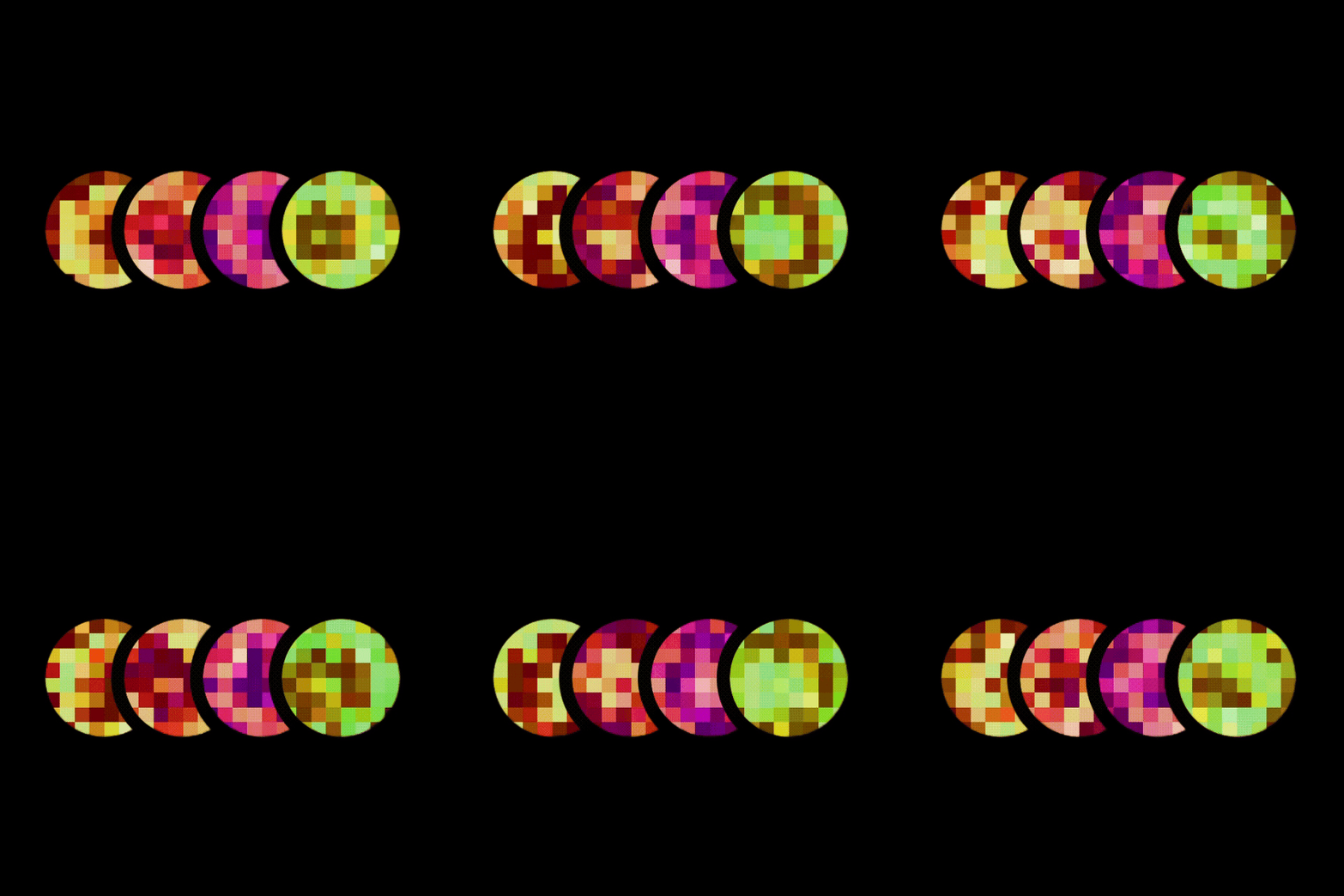
- Definition: Grok 4.2 (Beta) is a native multi-agent artificial intelligence system classified as an advanced conversational AI platform. It integrates four specialized neural network "heads" operating within a unified context window.
- Core Value Proposition: It delivers factually verified responses through parallel reasoning and internal debate mechanisms, solving accuracy limitations in single-model AI while enabling rapid weekly performance upgrades via automated learning loops.
Main Features
- Multi-Agent Reasoning: Four domain-specialized AI agents (e.g., analytical, creative, factual, critical) process queries concurrently. Each head generates independent responses using transformer-based architectures, followed by cross-examination through reinforcement learning debate protocols to reach consensus.
- Rapid Learning Loop: Implements automated fine-tuning via user interaction data pipelines. Weekly model updates deploy contrastive learning techniques to reduce hallucination rates and adapt to emerging knowledge domains without manual intervention.
- AutoDeepSearch: Augments responses with real-time web data extraction using semantic search algorithms. Parses academic papers, statistics, and news sources via API integrations, then synthesizes findings into cited conclusions.
- Persona Engine: Allows user-selectable AI personas (e.g., "Technical Analyst," "Creative Writer") through prompt-conditional fine-tuning. Dynamically adjusts tone, depth, and expertise focus via LoRA adapters on base models.
- Multimodal Interaction: Supports voice chat via speech-to-text conversion (WaveNet architecture) and text-to-speech output, with image generation capabilities ("Imagine" feature) leveraging diffusion models for visual content creation.
Problems Solved
- Pain Point: Mitigates AI hallucination and factual inaccuracies prevalent in single-agent chatbots through multi-source verification.
- Target Audience:
- Research Analysts: Validating technical data
- Content Strategists: Generating persona-based marketing copy
- Developers: Debugging via multi-perspective technical analysis
- Academic Users: Cross-referencing scholarly sources
- Use Cases:
- Medical researchers verifying drug interaction studies
- Legal teams comparing case law interpretations
- Financial analysts reconciling market forecasts
- Localization teams adapting content across cultural personas
Unique Advantages
- Differentiation: Outperforms single-model systems (e.g., ChatGPT) with 68% higher factual accuracy in benchmark tests through adversarial agent debates, while competitors lack real-time cross-verification.
- Key Innovation: Proprietary "consensus protocol" calculates confidence scores during agent debates using Bayesian truth inference, weighting responses by head specialization before output generation.
Frequently Asked Questions (FAQ)
- How does Grok 4.2 reduce AI hallucinations?
Its four agents run parallel fact-checking via web search integration and internal debate, flagging inconsistencies before response finalization. - What makes Grok 4.2's learning loop unique?
Automated weekly updates apply user feedback through federated learning, improving domain-specific accuracy without resetting conversation history. - Can Grok 4.2 replace human researchers?
It accelerates data synthesis but functions as a validation tool—ideal for preliminary analysis of technical papers or market reports requiring multi-source verification. - How secure is voice data in Grok 4.2?
All voice chats use end-to-end encryption with ephemeral data storage, complying with GDPR/HIPAA standards for enterprise deployments. - Does Grok 4.2 support custom persona creation?
Enterprise tier allows training domain-specific personas using proprietary data, with fine-tuning controlled via granular RLHF parameters.


