Product Introduction
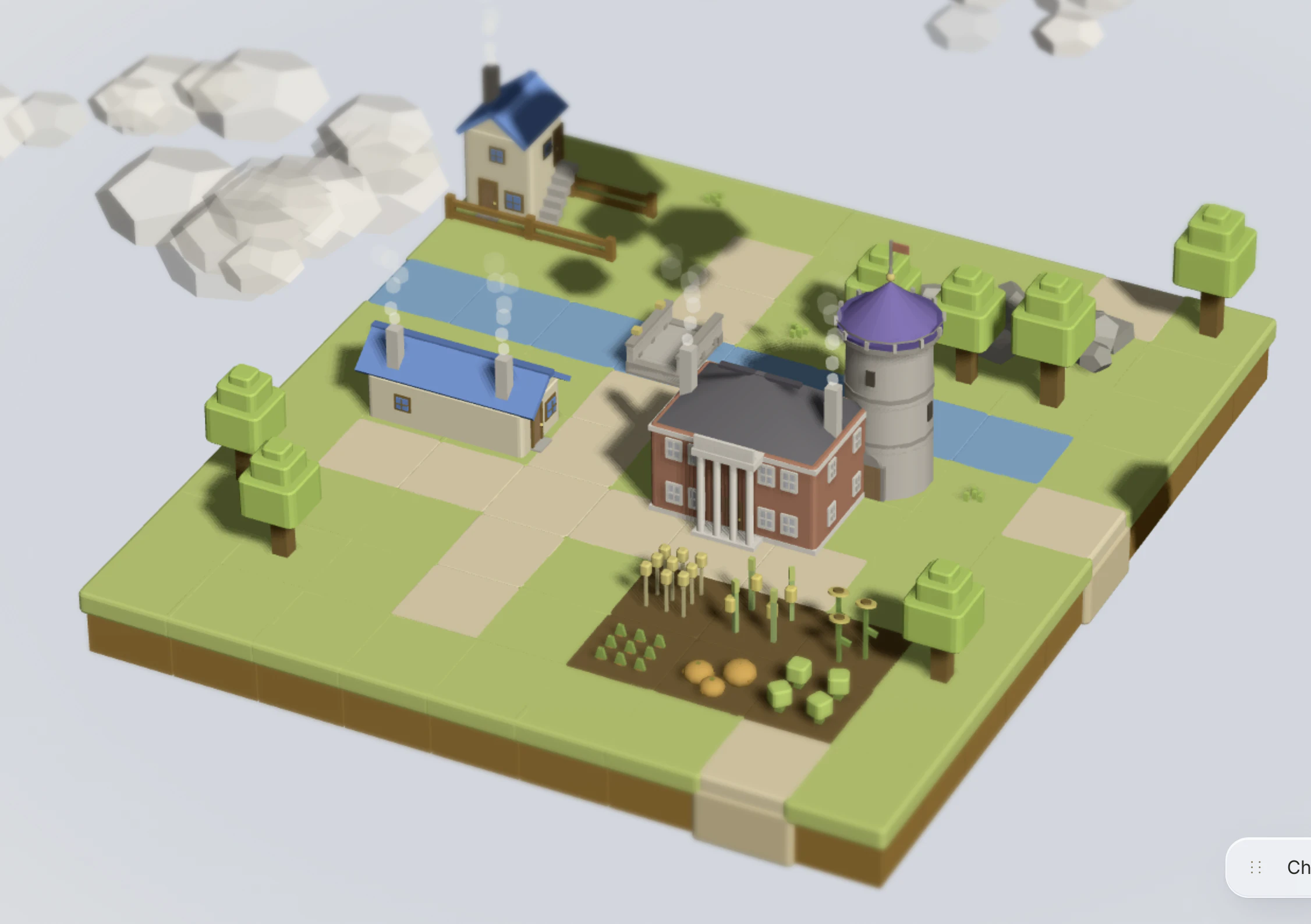
- Definition: Tiny World Builder is a browser-based, AI-assisted digital sandbox and world-building platform. Technically, it is a procedural content generation tool that uses tile-based (voxel-like) systems and generative AI to create and manipulate interactive, small-scale 3D environments.
- Core Value Proposition: It exists to democratize 3D world creation, offering a relaxing, intuitive, and accessible platform for building, exploring, and sharing detailed miniature worlds without requiring coding or complex 3D modeling software. Its primary value lies in automated tile adaptation, AI-powered world generation, and multi-platform export to VR and AR.
Main Features
- Adaptive Tile-Based Building System: The core mechanic allows users to place tiles representing terrain, buildings, trees, and infrastructure. The system's key innovation is procedural adjacency rules; placing a new tile next to an existing one can automatically change both to create coherent structures like connected fences, building clusters, or winding paths. This works through a predefined rule set governing how different tile types interact, eliminating manual adjustments for basic aesthetics.
- Multi-Mode Camera & Interactive Exploration: The platform supports several camera views for both creation and immersion. These include a Top-down editor view, an Isometric angled perspective, a Perspective orbit mode, and a fully interactive Walk (first-person) mode with WASD/mouse controls for jumping and exploring the created world. This allows the product to function as both a creation tool and a lightweight game engine for the built environments.
- AI-Powered & Procedural World Generation: Users can generate entire worlds via text prompts to integrated LLMs (OpenAI, Anthropic, xAI) or through a non-AI, seed-based procedural generator. The AI interprets natural language (e.g., "a coastal village with mountains") and constructs the world using the platform's primitive set (terrain, paths, fences, buildings). The procedural generator uses sliders for Composition (grass, forest, water, farmland, settlement ratios) and Elevation (plains, hills, mountains) to create worlds offline from a numeric seed.
- Dynamic Environment & Rendering Controls: A comprehensive settings panel allows fine-tuned control over the world's ambiance. Users can adjust Time of day, Season (Spring, Summer, Autumn, Winter), and Weather (Clear, Cloudy, Rain, Storm, Snow) with independent intensity and splash/buildup sliders. Rendering settings for shadow quality, resolution, lighting, and post-processing (brightness, saturation, contrast) are also exposed, enabling optimization for performance or visual fidelity.
- Cross-Platform Deployment & API: Created worlds are not static. They can be entered in VR for immersive exploration, projected onto a physical desk in AR, or simply shared via link. For developers, the platform offers a RESTful API with Bearer token authentication. Features include outbound webhooks for build events and an inbound SSE (Server-Sent Events) relay URL to push external commands and data into the world, enabling integration with other applications.
Problems Solved
- Pain Point: The high technical barrier and time investment required for traditional 3D world creation and prototyping. Software like Blender or Unity has a steep learning curve.
- Target Audience: Hobbyist Creators & Digital Artists seeking a relaxing creative outlet; Game Designers & Prototypers needing rapid environment mock-ups; Educators & Storytellers creating interactive scenes; Developers looking for an embeddable, configurable 3D environment for web projects.
- Use Cases: Rapidly prototyping a village layout for a game idea; creating a serene diorama for relaxation or mindfulness; building an interactive scene for a tabletop RPG campaign; developing an AR showcase for a product or architectural concept; using the API to create a data-visualization landscape.
Unique Advantages
- Differentiation: Unlike static diorama builders or complex game engines, Tiny World Builder combines the ease of a click-and-place tile editor with the power of AI generation and the interactivity of a real-time engine. Competitors often lack the integrated AI prompt-to-world feature, the adaptive tile system, or the direct export to VR/AR.
- Key Innovation: The context-aware, adaptive tile placement system is a significant technical innovation. Instead of placing hundreds of unique assets, users place "intentions" (e.g., "fence" or "house corner"), and the system automatically renders the correct connecting model. This massively accelerates the workflow and ensures visual coherence.
Frequently Asked Questions (FAQ)
- Is Tiny World Builder free to use? The core building and generation features are accessible through the web app. Advanced features like AI generation using proprietary models may require users to supply their own API keys, and premium tiers for increased save slots or cloud features are a common model for such platforms.
- Can I download or export my Tiny World creation? Yes, the platform includes Export and Render functions. You can likely export the world data for backup or import, and render images or videos of your creation. The most unique exports are to VR for immersive viewing and AR for placing your world on a physical surface.
- What is the difference between AI generation and the procedural seed generator? AI Generation uses a language model to interpret a text prompt and creatively place tiles, potentially creating more narrative-driven or unexpected worlds. The Procedural (Seed) Generator uses a deterministic algorithm based on sliders and a seed number; it's offline, faster, and perfectly reproducible, making it better for specific biome ratios and elevation control.
- How does the API work for developers? Developers can generate API keys to create integrations. The API provides webhooks that send JSON POST events to your server when users place/erase tiles. Conversely, you can push commands to a world via an SSE stream, allowing external applications (like a chat bot or data feed) to dynamically modify the world in real-time.
- What are the system requirements to run Tiny World Builder? As a WebGL-based application running in a modern browser, it requires a device with reasonable graphics capabilities. For the best experience with higher board sizes (like 32x32 or 48x48) and high shadow quality, a dedicated GPU is recommended. The walk mode and VR features are particularly performance-intensive.