
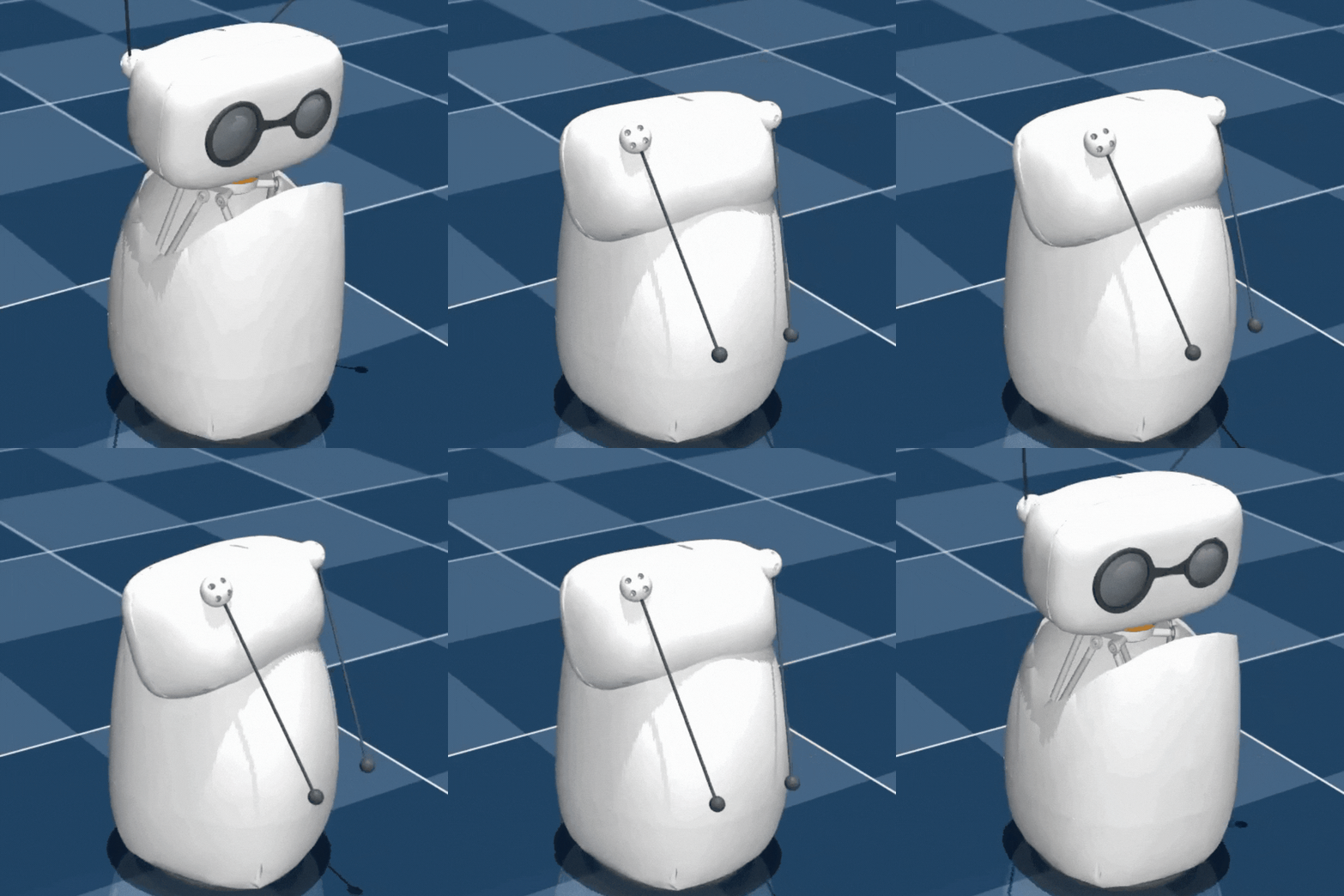
Product Introduction
- Reachy Mini is an open-source, desktop-sized robot kit developed collaboratively by Pollen Robotics and Hugging Face for AI experimentation and creative coding applications. The robot features 6 degrees of freedom in head movement, animated antennas, and multimodal sensors including a wide-angle camera and multiple microphones. It ships as an assemble-it-yourself kit with two versions: a wired Lite model ($299) and a wireless Compute model ($449) with onboard Raspberry Pi 5 and battery.
- The core value lies in democratizing physical AI development through affordable hardware, seamless integration with Hugging Face's AI ecosystem, and community-driven knowledge sharing. It enables real-world testing of vision, speech, and interaction models while maintaining full open-source transparency across hardware designs, Python SDK, and simulation environments.
Main Features
- Full programmability through Python SDK with native integration for Hugging Face Transformers, Diffusers, and Safetensors libraries, enabling direct deployment of state-of-the-art AI models for real-time audio-visual interactions. Future updates will add JavaScript and Scratch support for educational applications.
- Modular sensing array including 4 microphones (Compute version), 5W speaker, wide-angle RGB camera, and 6-axis accelerometer, designed for multimodal AI experiments in human-robot interaction scenarios. Sensor data streams are accessible through standardized APIs compatible with PyTorch and TensorFlow frameworks.
- Offline simulation SDK allows pre-deployment testing of robot behaviors in digital twin environments, reducing hardware dependency during development cycles. The simulation environment replicates exact motor specifications (0.1° servo precision) and sensor characteristics for behavior validation.
Problems Solved
- Addresses the accessibility gap in physical AI development by offering enterprise-grade sensor capabilities at consumer pricing (starting at $299), significantly lower than industrial robotics platforms averaging $5,000+.
- Serves multiple user segments: AI developers prototyping human-robot interaction models, educators teaching robotics/AI concepts, hobbyists building custom behaviors, and researchers testing embodied AI systems in controlled environments.
- Enables practical implementation of voice-controlled assistants, emotion recognition systems, educational storytelling robots, and experimental human-robot collaboration setups through its combination of precise motion control (11" height with 6-DoF head movement) and AI-ready sensor payload.
Unique Advantages
- Differentiates from comparable educational robots like TurtleBot or Misty II through direct Hugging Face Hub integration, offering one-click deployment of 15+ pre-trained behavior models including object recognition, speech response, and gesture sequences at launch.
- Implements unique dual-antenna LED system for non-verbal communication, programmable through RGB values and animation patterns to convey operational states or emotional responses without speech output.
- Combines Raspberry Pi 5 compute power (Wireless version) with hardware-accelerated AI inference through Hugging Face Optimum framework, achieving 12ms latency for vision pipelines and 200ms end-to-end response time for voice interactions.
Frequently Asked Questions (FAQ)
- What pre-built behaviors are included? The launch package contains 15+ Hub-hosted behaviors including face tracking (using MediaPipe), voice command recognition (with Wav2Vec2), object detection (YOLOv8 implementation), and emotional response patterns using text-to-speech models.
- When will Windows support be available? The SDK currently supports Mac and Linux, with Windows compatibility scheduled for Q4 2025 through a WSL2-based solution being tested in public beta.
- How does the simulation SDK work? Developers can test motor controls and sensor outputs in a Unity-based virtual environment that mirrors physical unit specifications, with API compatibility ensuring seamless code migration to hardware.
- What community resources exist? Users share custom behaviors through Hugging Face Spaces, with 120+ community models already uploaded for gesture control, multilingual support, and educational games.
- What's the shipping timeline? Lite version ships in late summer 2025 via DHL Express, while Compute version ships in phased batches from fall 2025 through 2026 based on production capacity.


