
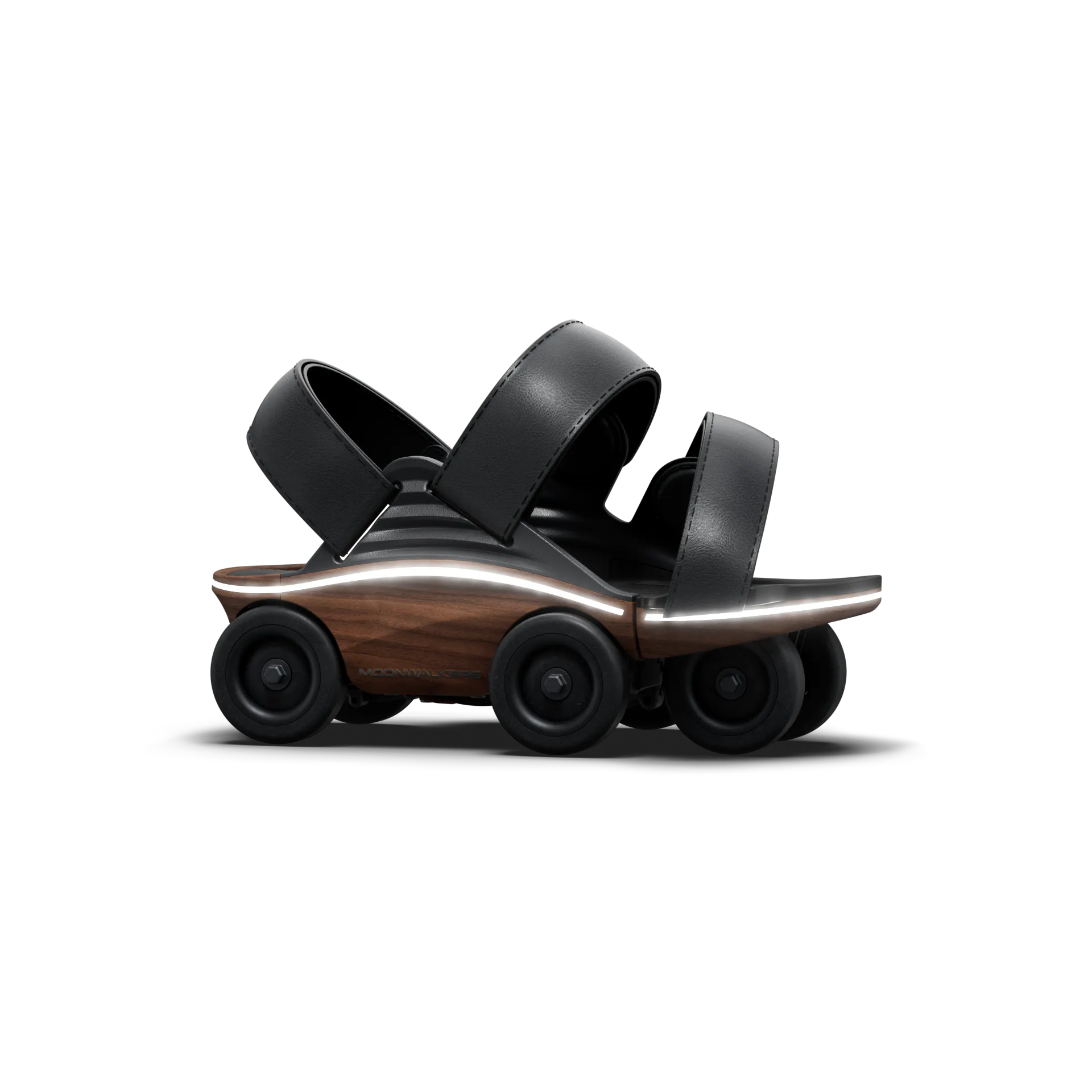
Product Introduction
- Definition: The Moonwalkers Dusk is a lightweight, wearable robotic mobility device designed to augment human walking. Technically categorized as powered footwear or personal electric transportation, it consists of a pair of motorized overshoes that strap onto existing footwear.
- Core Value Proposition: It exists to increase walking speed and efficiency without changing the user's natural gait. Its primary value is transforming a standard walk into a faster, less fatiguing commute or errand run, effectively extending personal mobility range. Key keywords: electric walking shoes, robotic shoes, personal mobility device, commute faster, walk assist technology.
Main Features
- ShiftOS with SENSA™ Adaptive Intelligence: This is the proprietary operating system and sensor suite. It uses adaptive recognition algorithms to read the user's movement intent and stride rhythm in real-time, matching motor response to create a seamless assistive feel. It employs terrain-aware control, automatically adjusting torque and power delivery for surfaces like gravel, grass, or wet pavement to maintain traction and stability. The system can also detect a transition from a walk to a run and adjust assistance accordingly.
- Tri-Size Platform with Optimized Performance: Unlike one-size-fits-all models, Dusk comes in three distinct sizes (Small, Medium, Large). Each size has tailored performance specs: Small and Medium offer 7 mph top speed and 3.8 lbs per shoe, while the Large size provides 8 mph top speed but weighs 4.2 lbs per shoe. This sizing ensures a more secure fit, reduces fatigue, and optimizes the power-to-weight ratio for different user foot sizes and weights (with user limits of 175 lbs for S/M and 220 lbs for L).
- Integrated Lighting & Status System: The Dusk model features a full wraparound LED light strip that serves dual purposes. It provides ground illumination for visibility in low-light conditions. It also acts as a multi-color status indicator: green for active movement assist, pink for indoor mode, blue for firmware updates, and red for alerts or errors, offering immediate user feedback on the device's operational state.
Problems Solved
- Pain Point: The "last-mile" problem in urban commuting and short-distance travel, where distances are too far to walk comfortably yet too short or congested for cycling or driving. It also addresses walking fatigue and time inefficiency for daily errands, campus travel, or large facility navigation (e.g., warehouses, airports).
- Target Audience: Urban commuters, college students on large campuses, logistics and warehouse workers, tech enthusiasts seeking novel mobility solutions, and individuals looking to increase daily step count or commute efficiency without sweating.
- Use Cases: Essential for commuting from a transit station to the office (0.5-2 miles), running quick errands within a neighborhood, navigating expansive corporate campuses or trade show floors, and for tourism where covering more ground on foot is desired.
Unique Advantages
Strengths & Limitations (Pros & Cons):
- Pros: Significant speed boost (up to 7-8 mph) over normal walking; maintains natural walking biomechanics unlike scooters or skates; compact and carryable with included sling case; modular design with swappable straps and wheels for longevity; USB-C charging for convenience.
- Cons: High price point ($1,199); limited range (~6.3 miles) per charge restricts longer journeys; weight (3.8-4.2 lbs per shoe) is noticeable when carrying; not designed for running or off-road trails; requires a learning curve for balance and control.
Key Alternatives & Differentiation:
- Electric Kick Scooters (e.g., Xiaomi, Segway): Pros: Higher speed (15-20 mph), longer range (15-30 miles), lower cost. Cons: Less portable, requires standing in one posture, illegal on sidewalks in some areas. Differentiation: Moonwalkers are hands-free, sidewalk-legal, and use a more natural walking motion.
- Electric Skates/One-wheels (e.g., InMotion, Onewheel): Pros: Fun, carving experience. Cons: Steep learning curve, higher injury risk, not hands-free. Differentiation: Moonwalkers have a lower skill barrier, are safer for sudden stops, and don't require a skating posture.
- Previous Moonwalkers Models: The Dusk is 40% lighter and 15% smaller than the first generation. Compared to the Moonwalkers Aero, Dusk offers a lighter-weight option (3.8 lbs vs 4.2 lbs for S/M) and integrated lighting, while Aero may prioritize other rugged features.
Frequently Asked Questions (FAQ)
- How fast do Moonwalkers Dusk electric shoes go? The Moonwalkers Dusk has a top speed of 7 mph for Small and Medium sizes, and 8 mph for the Large size, effectively doubling or tripling average human walking speed.
- What is the range of the Moonwalkers Dusk on a single charge? The estimated range is 6.3 miles (approximately 10 kilometers) on a full charge, depending on factors like user weight, terrain, and speed.
- Can you run or go up stairs in Moonwalkers Dusk? No, they are not designed for running or climbing stairs. The SENSA system is optimized for walking gait. To navigate stairs or run, you must deactivate the wheels and walk normally or carry them.
- Are Moonwalkers Dusk waterproof? They are water-resistant with an IPX4 rating, meaning they can withstand splashes of water from any direction. They are not waterproof and should not be submerged or used in heavy rain.
- How do you charge Moonwalkers Dusk robotic shoes? Each shoe charges independently via a USB-C port using a provided Power Delivery (PD) compatible charger. A full charge takes approximately 1.5 hours, and they can also be charged with compatible USB-C power banks.


