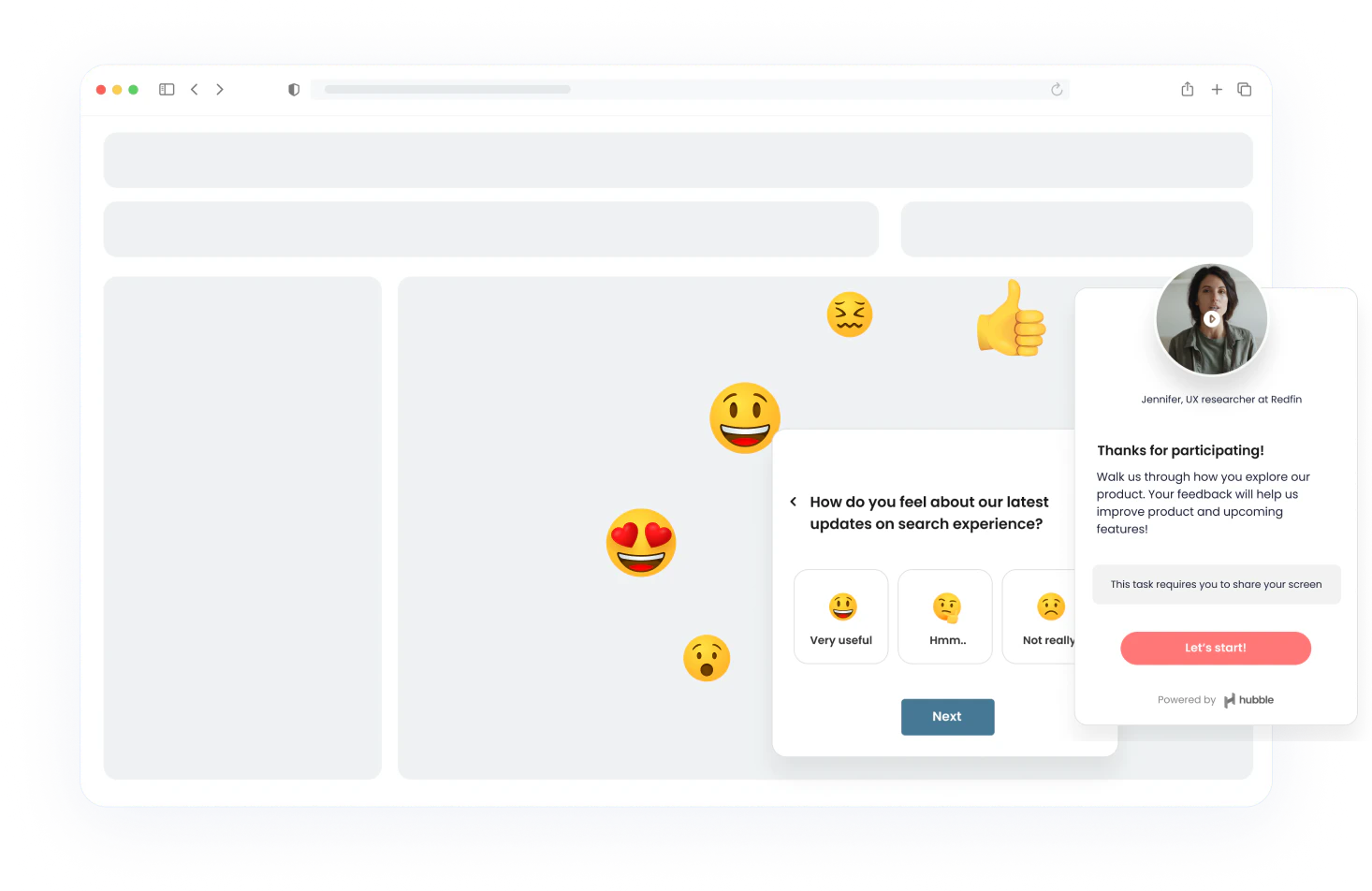
Product Introduction
Definition: Hubble Technologies Inc. is an all-in-one enterprise user research and usability testing platform designed to streamline the end-to-end product discovery lifecycle. It functions as a centralized hub for UX research, combining unmoderated testing, AI-driven moderated interviews, and professional participant recruitment into a single, integrated Software-as-a-Service (SaaS) ecosystem.
Core Value Proposition: Hubble exists to eliminate the fragmentation of user research workflows by providing a comprehensive suite of tools for rapid prototype validation and qualitative data collection. By integrating advanced AI capabilities for synthesis and recruitment, Hubble allows product and design teams to gain actionable insights up to 55% faster than traditional methods, effectively bridging the gap between design concepts and market-ready products.
Main Features
Comprehensive Unmoderated Research Suite: Hubble provides a specialized environment for executing asynchronous usability tests. This includes Prototype Testing for Figma and other design tools, Website Testing for live URLs, and Mobile App Testing for native environments. Technically, the platform utilizes task-based recording and heatmapping to capture user interactions, while specialized tools like Card Sorting and Tree Testing allow researchers to optimize information architecture (IA) and navigation structures based on quantitative user data.
AI-Moderated Interview Technology: A standout technical feature is the Hubble MCP (Multi-Capability Platform), which introduces AI-moderated interviews. This technology leverages Large Language Models (LLMs) to conduct automated, conversational sessions that mimic human moderators. The system can probe for deeper insights, ask follow-up questions based on participant responses, and record sessions for immediate transcription and sentiment analysis, enabling qualitative research to scale without the linear time constraints of manual moderation.
Integrated Participant Recruitment & Management: Hubble streamlines the sourcing of high-quality testers through direct integrations with enterprise-grade participant pools such as User Interviews and Respondent. The platform utilizes advanced filtering and screener logic to target specific demographics, including niche B2B professional segments and consumer audiences. This integration reduces participant recruitment time by up to 10x, ensuring that research studies reach the correct user personas within hours rather than days.
Advanced Research Synthesis & AI Reporting: Post-study analysis is automated through Hubble’s powerful synthesis engine. The platform uses AI to annotate, tag, and categorize video insights and survey responses. It automatically generates executive summaries and key takeaways, transforming raw video data and quantitative metrics into structured reports that help product managers and stakeholders make data-driven decisions regarding product strategy and feature prioritization.
Problems Solved
- Pain Point: Research Bottlenecks and Tool Fragmentation. Many UX teams struggle with "tool sprawl," using separate apps for recruitment, testing, and analysis, which leads to data silos and slow turnaround times. Hubble solves this by consolidating the entire stack into one platform.
- Target Audience: The platform is engineered for Senior UX Researchers, Product Designers, Product Managers, and Marketing Teams within enterprise environments (e.g., organizations like Greenhouse) who require scalable, secure, and fast-moving research capabilities.
- Use Cases:
- Design Validation: Validating high-fidelity prototypes before engineering handoff to reduce development waste.
- Continuous Discovery: Running recurring unmoderated studies to gather feedback on live web and mobile products.
- Information Architecture Optimization: Using tree testing and card sorting to reorganize complex site navigations.
- Marketing Asset Testing: A/B testing marketing copy and creative assets to increase ROAS (Return on Ad Spend).
Unique Advantages
- Differentiation: Unlike competitors like Maze or UserTesting, Hubble offers a more integrated approach to both qualitative and quantitative methods, particularly with its AI-moderated interview capabilities. It provides a more modern, intuitive UI/UX for researchers while maintaining enterprise-grade security standards that legacy platforms often lack.
- Key Innovation: The core innovation lies in the platform's AI-assisted synthesis and its ability to handle both "In-Product Research" (gathering feedback directly within the live application) and external "Participant Recruitment" simultaneously. Furthermore, Hubble is SOC2 Type II, HIPAA, and GDPR compliant, making it a viable solution for highly regulated industries such as healthcare and fintech.
Frequently Asked Questions (FAQ)
How does Hubble compare to Maze and UserTesting? Hubble distinguishes itself by offering a more comprehensive "all-in-one" experience that includes both advanced unmoderated tools and AI-moderated interview features. While Maze focuses heavily on unmoderated prototype testing and UserTesting provides a large panel, Hubble offers superior flexibility in study customization and more advanced AI-driven synthesis tools for faster reporting.
Can I recruit specific B2B participants for my research studies? Yes, Hubble offers 10x faster recruitment for B2B participants by leveraging deep integrations with premium participant pools. Researchers can set complex screener questions and demographic filters to ensure they are testing with the exact target audience, whether they are specialized professional workers or specific consumer segments.
What security and compliance standards does Hubble follow? Hubble is built for the enterprise and is fully compliant with SOC2 Type II, HIPAA, and GDPR. This ensures that participant data and proprietary design assets are protected by industry-leading security protocols, making it suitable for large-scale corporate research initiatives.
What types of prototypes can be tested on Hubble? Hubble supports unmoderated prototype testing for a variety of platforms, most notably Figma. It allows researchers to set specific tasks, record user sessions (video, audio, and screen), and track success rates, time-on-task, and click maps to validate design choices before moving into the development phase.