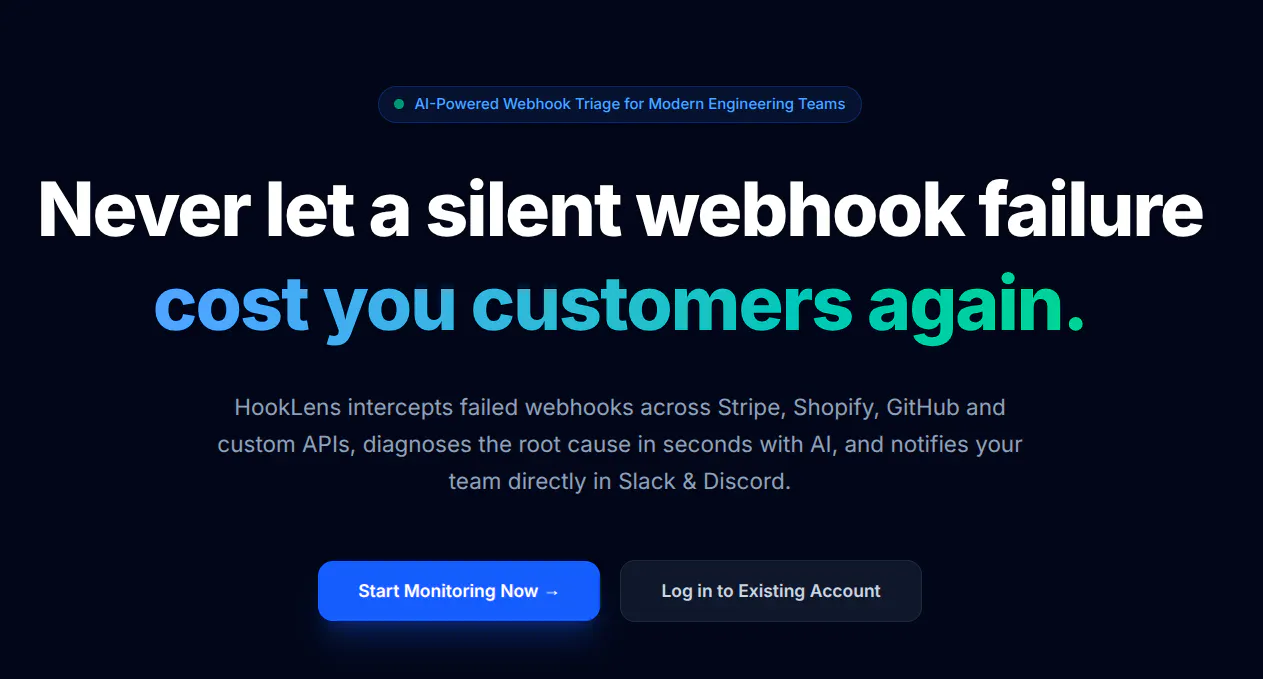
Product Introduction
- Definition: HookLens is a SaaS (Software-as-a-Service) platform for webhook monitoring, triage, and debugging. It operates as a reverse proxy or intermediary layer that captures, analyzes, and manages HTTP webhook payloads from external services before they reach your application's primary endpoint.
- Core Value Proposition: HookLens exists to eliminate revenue-critical webhook failures and reduce engineering time spent on debugging. Its primary value is providing instant, AI-powered root-cause analysis for failed Stripe, Shopify, and custom API webhooks, turning opaque JSON errors into actionable fixes and preventing customer churn due to silent payment or order processing failures.
Main Features
- AI-Powered Root-Cause Analysis: This feature uses Google's Gemini AI model to parse failed webhook payloads and error logs. It works by ingesting the raw JSON data, HTTP status codes, and headers, then cross-referencing this with common failure patterns (e.g., signature verification errors, payload schema mismatches, idempotency key conflicts) to generate a plain-English diagnosis and often a code-ready suggestion for the fix.
- Multi-Platform Webhook Interception & Proxy: HookLens provides dedicated, secure endpoint URLs for services like Stripe and Shopify. It acts as a managed proxy, receiving webhooks first, logging them, performing health checks, and then reliably forwarding them to your internal infrastructure. This ensures no webhook is lost even if your primary application is temporarily down.
- Real-Time Alerting to Collaboration Hubs: The platform integrates natively with Slack and Discord. It works by configuring alert rules based on webhook failure status, latency spikes, or specific error types. When a failure is detected, HookLens dispatches a formatted alert to the designated channel, including the AI diagnosis and a direct link to the full payload and logs for immediate triage.
- Centralized Webhook Logging & Retention: All webhook events (successful and failed) are captured and stored in a searchable dashboard. Retention periods vary by plan (7 to 90 days). This feature works by indexing each event's payload, headers, response status, and latency, allowing developers to perform historical analysis, audit trails, and replay events to staging environments for testing.
Problems Solved
- Pain Point: Silent webhook failures that lead to data desynchronization, missed payments, unfulfilled orders, and degraded user experience without any immediate alert to the engineering team.
- Target Audience: DevOps engineers, backend developers, and platform teams in e-commerce, SaaS, and fintech companies who integrate with Stripe, Shopify, GitHub, and other webhook-reliant APIs. Specifically, technical leads responsible for payment processing reliability and full-stack developers managing integrations.
- Use Cases: Diagnosing a failed
invoice.payment_failedStripe webhook before a customer's subscription is incorrectly canceled; identifying and fixing aorders/createShopify webhook failure that is causing abandoned carts; monitoring custom API webhooks for third-party services to ensure data pipeline integrity; providing new engineers with immediate context for webhook-related bugs without digging through server logs.
Unique Advantages
- Differentiation: Unlike generic API monitoring tools (e.g., UptimeRobot) or simple log aggregators, HookLens is purpose-built for the stateful, asynchronous nature of webhooks. It surpasses manual debugging in developer consoles or building in-house proxy systems by offering integrated AI analysis and direct collaboration tool alerts out-of-the-box.
- Key Innovation: The integration of Gemini AI specifically for webhook payload interpretation is its core innovation. This moves beyond simple logging to intelligent diagnosis, contextualizing cryptic API error codes within the specific framework of webhook delivery, which dramatically reduces mean time to resolution (MTTR).
Frequently Asked Questions (FAQ)
- How does HookLens handle webhook security and signature verification? HookLens validates critical webhook signatures (like Stripe-Signature) at the proxy layer before processing. It securely stores your endpoint secrets and forwards the validated payload, ensuring the integrity and authenticity of the webhook data is maintained throughout the pipeline.
- Can HookLens monitor webhooks from custom or in-house APIs? Yes, HookLens supports monitoring for custom webhook endpoints. You can configure a target URL within HookLens to act as a proxy for any HTTP webhook, enabling logging, alerting, and AI analysis for internal or third-party APIs beyond the pre-configured integrations.
- What happens if the HookLens service experiences downtime? HookLens is designed for high availability. However, to prevent a single point of failure, it is recommended to keep your original webhook endpoint URL as a fallback. The platform's architecture aims for minimal latency overhead and high uptime, with priority SLA support included in higher-tier plans.
- Is there a risk of data exposure with AI analyzing our webhook payloads? HookLens's AI analysis is designed to focus on error structure and common patterns. For maximum security, users on the Scale plan or with specific compliance needs can often request controls related to data processing. It is advised to review their data processing agreement for specifics on encryption and data handling.