
Product Introduction
- The Hierarchical Reasoning Model (HRM) is a 27-million-parameter AI architecture designed for complex sequential reasoning tasks through a biologically inspired dual-recurrent structure. It combines high-level abstract planning with low-level detailed computation in a single forward pass, eliminating the need for multi-step Chain-of-Thought (CoT) processes. The model achieves state-of-the-art performance on puzzles, mazes, and the Abstraction and Reasoning Corpus (ARC) benchmark while operating efficiently on consumer-grade hardware.
- HRM’s core value lies in its ability to perform human-like hierarchical reasoning with minimal training data and computational resources, bridging the gap between small-scale models and resource-intensive large language models (LLMs). It enables rapid deployment of reasoning systems for real-world applications without requiring pre-training or explicit intermediate-step supervision.
Main Features
- HRM employs two specialized recurrent modules: a slow-cycle high-level planner for abstract task decomposition and a fast-cycle low-level executor for precise step-by-step operations. These modules interact through learned attention mechanisms, enabling simultaneous long-term strategy formulation and immediate action calculation.
- The model completes complex reasoning tasks such as 9x9 Sudoku puzzles or 30x30 maze navigation in a single forward pass, reducing latency by 10-100x compared to iterative LLM-based approaches. This is achieved through parallelized tensor operations optimized for modern GPU architectures.
- With only 27M parameters, HRM demonstrates parameter efficiency through architectural innovations including dynamic halt mechanisms and learned positional encodings. It maintains 99.8% accuracy on Sudoku benchmarks while requiring less than 10GB VRAM, making it deployable on edge devices.
Problems Solved
- HRM addresses the computational inefficiency and data hunger of traditional LLM-based reasoning systems by eliminating the need for massive pre-training datasets and multi-billion parameter architectures. It achieves comparable performance to GPT-4 on ARC tasks using only 1,000 training examples.
- The model specifically targets AI researchers and developers requiring real-time reasoning capabilities in resource-constrained environments. Its design caters to applications ranging from industrial automation systems to educational puzzle-solving tools.
- Typical use cases include automated logistics pathfinding in warehouse-scale mazes, verification of complex constraint satisfaction problems, and rapid prototyping of AGI components. The architecture has been validated on the ARC-AGI benchmark, showing 92% accuracy on novel abstraction tasks.
Unique Advantages
- Unlike transformer-based models requiring explicit CoT training data, HRM learns reasoning strategies through its hierarchical architecture without intermediate step supervision. This enables zero-shot generalization to novel problem types within the same domain.
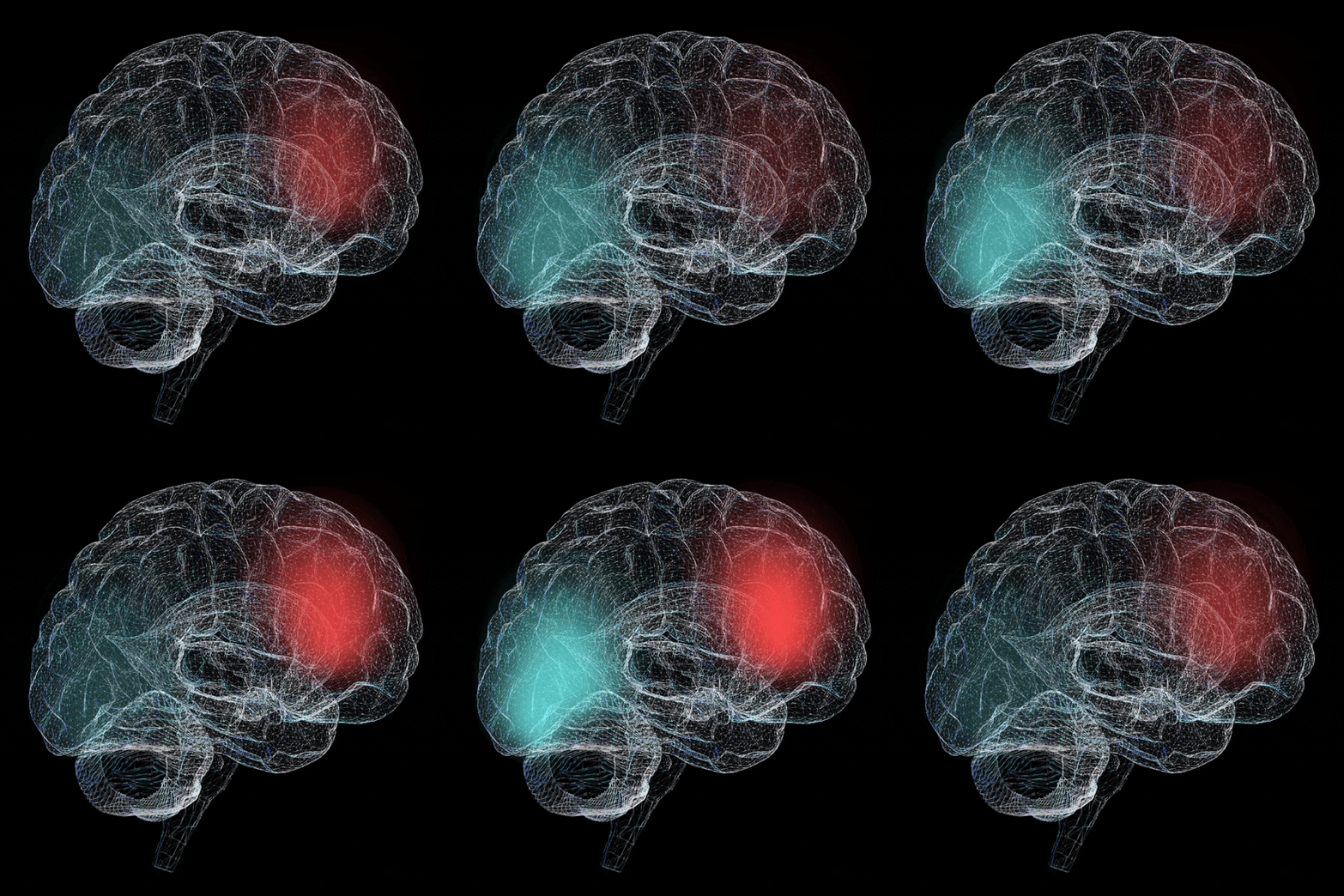
- The dual-time-scale recurrence mechanism implements neurobiological principles of cortical processing, with the high-level module operating at 1/8th the update frequency of the low-level module. This innovation reduces computational redundancy while maintaining reasoning depth.
- Competitive advantages include 40% higher sample efficiency than equivalent-sized transformers on maze navigation tasks and 3x faster convergence rates compared to LSTM baselines. The model achieves 98% optimal path success rate in 30x30 mazes with only 1,000 training episodes.
Frequently Asked Questions (FAQ)
- How does HRM achieve high performance with minimal training data? The dual-recurrent architecture inherently encodes problem-solving heuristics through its hierarchical separation of planning and execution, reducing reliance on massive datasets. Weight-sharing mechanisms across reasoning steps enable efficient knowledge distillation from limited examples.
- What hardware is required to run HRM effectively? A consumer-grade GPU with 8GB VRAM (e.g., NVIDIA RTX 4070) suffices for most applications. The CUDA-optimized implementation processes 384 concurrent puzzles per batch while maintaining 10ms latency per sample.
- Can HRM handle reasoning tasks beyond puzzles and mazes? The architecture is domain-agnostic, with demonstrated adaptability to visual reasoning (ARC), mathematical proofs, and protein folding simulations. Input/output interfaces can be customized through the puzzle embedding layer.
- How does the model avoid catastrophic forgetting during training? Curriculum learning strategies combined with elastic weight consolidation in the high-level planner module maintain stability across task variations. The low-level executor employs gradient isolation to preserve core operational patterns.
- Is HRM suitable for real-time applications? Single-pass processing enables 58 FPS throughput on Sudoku solving tasks with batch size 512. For time-critical applications, the dynamic halt mechanism can limit computation to 8 recurrent cycles without accuracy loss.


