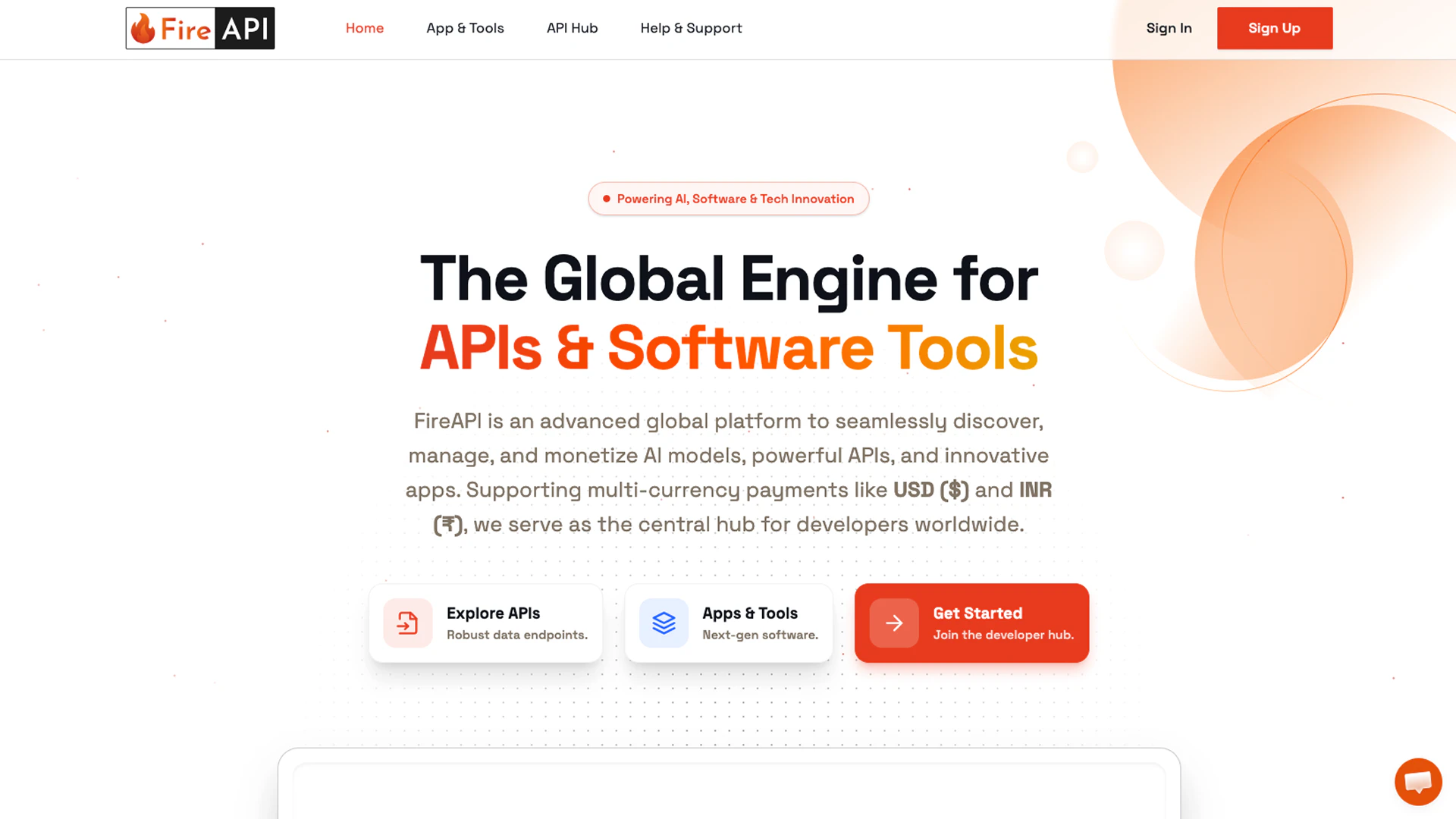
Product Introduction
Definition: FireAPI is a comprehensive, full-cycle API ecosystem and marketplace platform designed to facilitate the discovery, development, management, and commercialization of RESTful APIs and microservices. It functions as a centralized API Gateway and Hub where developers can host their backend logic and transform it into a scalable SaaS product.
Core Value Proposition: FireAPI exists to bridge the gap between technical API development and business monetization. It eliminates the overhead of building custom billing systems, authentication layers, and documentation portals. By providing a unified infrastructure for API monetization, real-time analytics, and automated web scraping, FireAPI enables startups and independent developers to achieve rapid time-to-market for their data-driven tools and software-as-a-service (SaaS) offerings.
Main Features
Global API Marketplace and Discovery: FireAPI hosts a vast repository of thousands of pre-integrated APIs across various categories including finance, AI, data extraction, and social media. The platform utilizes a standardized interface, allowing developers to test endpoints in a sandboxed environment before integration. This reduces friction in the procurement of third-party data and services.
Automated Web Scraping and Data Extraction: The platform features high-performance scraping solutions that handle complex challenges such as IP rotation, CAPTCHA solving, and headless browser rendering. Users can create custom scraping logic to transform unstructured web data into structured JSON format, effectively turning any website into a functional API without managing proxy infrastructure.
End-to-End API Monetization Engine: FireAPI provides a robust billing layer that supports flexible pricing models, including pay-per-use, tiered subscriptions, and freemium plans. It integrates with payment processors to automate invoicing, credit management, and revenue distribution, allowing creators to focus on code while the platform handles the commercial lifecycle.
Real-Time API Analytics and Monitoring: Every API deployed or managed through FireAPI is subject to granular monitoring. The dashboard provides technical metrics such as latency distributions, error rates (4xx and 5xx responses), throughput (Requests Per Second), and user-specific usage logs. This level of observability is critical for maintaining Service Level Agreements (SLAs) in enterprise environments.
Problems Solved
Pain Point: High Barrier to API Commercialization. Most developers struggle with the complexity of building a secure authentication layer (OAuth2/API Keys) and a recurring billing system. FireAPI provides these out-of-the-box, solving the "billing vs. building" dilemma.
Target Audience: The primary users include Full-Stack Developers seeking to monetize side projects, SaaS Founders looking for a backend infrastructure, Data Engineers requiring reliable web scraping pipelines, and Enterprise Architects looking to centralize internal API discovery.
Use Cases: Essential for building "Wrapper" startups (e.g., AI-powered content generators), creating price monitoring tools that require constant web scraping, providing niche data feeds for financial analysis, and managing internal microservices within a growing technology organization to prevent redundant development.
Unique Advantages
Differentiation: Unlike traditional API marketplaces that only act as a directory, FireAPI offers a vertical integration of the entire stack—from the scraping engine used to collect data to the billing engine used to sell it. It moves beyond "Listing" to "Infrastructure Provisioning."
Key Innovation: The platform's ability to seamlessly transition a local script into a production-ready, monetized API endpoint with a single deployment flow. Its specific innovation lies in the hybrid approach of providing both a consumer marketplace and a provider-side toolkit for lifecycle management.
Frequently Asked Questions (FAQ)
How does FireAPI handle API security and rate limiting? FireAPI implements an enterprise-grade API Gateway that manages authentication via API keys and JWTs. It allows providers to set granular rate limits and quotas per user tier, protecting backend resources from DDoS attacks and unauthorized over-usage.
Can I use FireAPI to monetize my existing Python or Node.js scripts? Yes, FireAPI is designed to wrap existing logic into a hosted API environment. By deploying your code to the platform or connecting your server, FireAPI adds the necessary documentation, billing, and monitoring layers required to turn a script into a commercial SaaS product.
What makes FireAPI’s scraping solutions better than custom-built scrapers? FireAPI manages the underlying infrastructure, including a rotating pool of residential and mobile proxies, which prevents IP blocking and regional restrictions. It uses advanced browser fingerprinting techniques to bypass bot detection systems that typically stop standard scraping libraries like BeautifulSoup or Scrapy.