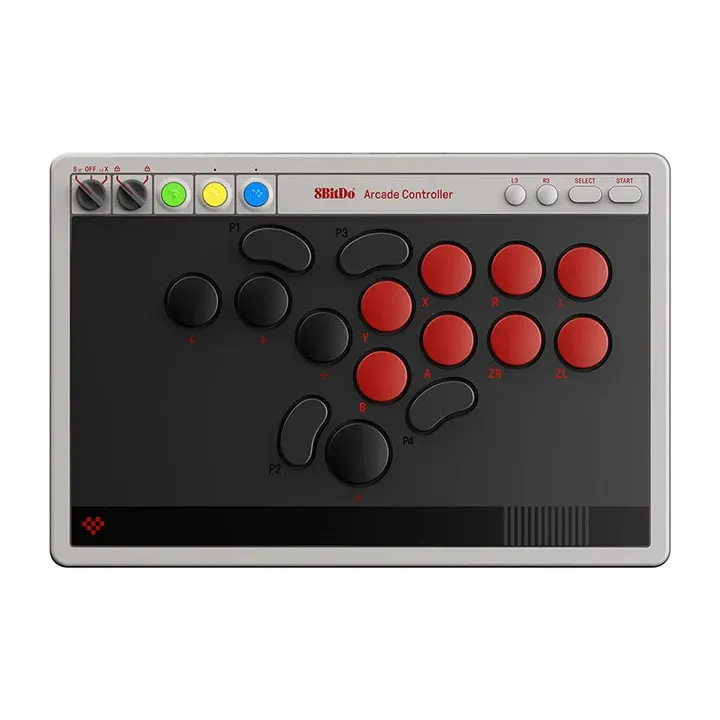
Product Introduction
- Definition: The 8BitDo Arcade Controller Pro is a high-end, all-button fight stick (also known as a hitbox-style controller) designed for competitive fighting games. It is a specialized PC gaming peripheral and Nintendo Switch controller that eschews a traditional joystick for a directional button layout, offering precise digital inputs.
- Core Value Proposition: It exists to provide tournament-level players and dedicated fighting game enthusiasts with a fully customizable, low-latency, and feature-rich arcade controller. Its core value lies in its compact layout for ergonomic hand positioning, on-device customization via a built-in display, and sponsor-grade build quality backed by 8BitDo's support of the Street Fighter League.
Main Features
- Compact, Ergonomic Button Layout: The controller features a tighter button spacing and smaller 24mm action buttons compared to standard arcade sticks. This compact fight stick layout reduces finger travel distance, allowing for faster, more comfortable inputs during extended gaming sessions and reducing hand strain.
- Integrated 1.47-inch Display & On-Device Software: A key differentiator is the built-in TFT display. It functions as a direct interface for the Built-in Ultimate Software, allowing users to view real-time input history, check battery level, adjust RGB lighting modes, and remap the five programmable (P1-P5) buttons without needing a separate PC or mobile app.
- Hot-Swappable Mechanical Switches & Modular Design: The controller uses proprietary 8BitDo Core Green low-profile linear mechanical switches, co-developed with Kailh. These hot-swappable switches allow users to change the actuation feel without soldering. The design is highly modular, featuring a quick-release tempered glass faceplate for easy access, a magnetic wrist rest with internal storage for spare parts, and replaceable lock caps to disable programmable buttons.
- Dual-Mode Low-Latency Connectivity & Cable Management: For PC, it uses a dedicated 2.4GHz wireless dongle for minimal input lag. For Nintendo Switch, it connects via Bluetooth. The wired connection is reinforced with a metal cable lock system on a swivel head, securing the USB-C cable during intense play. Dual USB-C ports (top and side) offer flexible cable routing.
Problems Solved
- Pain Point: Standard fight sticks can be large, heavy, and lack personalization. This controller solves this with a compact, desk-friendly footprint and deep hardware-level customization (switches, button caps, layout) to fit any player's preference.
- Target Audience: Primary users are competitive fighting game players (e.g., Street Fighter 6, Tekken 8, Guilty Gear Strive), speedrunners who require frame-perfect inputs, and modding enthusiasts who enjoy customizing their peripherals. Secondary users are Nintendo Switch owners seeking a premium arcade experience for games like Street Fighter 30th Anniversary Collection.
- Use Cases: Essential for tournament play (features a physical Tournament Lock switch), long practice sessions (ergonomic layout and wrist rest), streaming (dedicated capture button for Switch, clean aesthetics), and multi-platform fighters who play on both PC and Switch.
Unique Advantages
Strengths & Limitations (Pros & Cons):
- Pros: Unmatched level of built-in customization and modularity for its price point. The integrated display is a unique, quality-of-life innovation. The inclusion of spare parts (switches, puller, lock caps) is exceptional. Build quality with tempered glass and metal cable lock feels premium. Official sponsorship lends competitive credibility.
- Cons: The proprietary low-profile switches limit third-party switch compatibility compared to standard MX-style sockets. The compact layout may not suit players with very large hands. Lacks native PlayStation or Xbox compatibility, limiting its use for cross-platform tournaments on those consoles.
Key Alternatives & Differentiation:
- vs. Standard 8BitDo Arcade Controller: The "Pro" model is not an upgrade but a parallel product. It differentiates with a smaller button layout, the integrated display, hot-swappable switches, and a magnetic wrist rest, catering to players who prioritize customization and ergonomics over a traditional stick layout.
- vs. Premium Custom Hitboxes (e.g., Junkfood Arcades): The Arcade Controller Pro is a mass-produced, feature-complete solution at a lower entry price. It wins on out-of-the-box features (display, wireless, software) but may lose on ultimate customization (case materials, full SOCD editor, open-source firmware) offered by boutique builders.
- vs. Licensed Console Sticks (e.g., Hori Fighting Stick Alpha): It differentiates by being all-button, multi-platform (PC/Switch), and wireless. It trades the official PlayStation/Xbox licensing and larger form factor for a more specialized, portable, and customizable design for the PC/Switch competitive scene.
Frequently Asked Questions (FAQ)
Is the 8BitDo Arcade Controller Pro compatible with PlayStation 5 or Xbox Series X|S? No, it is not natively compatible with PlayStation or Xbox consoles. Its primary compatibility is with Windows PC (10/11) and Nintendo Switch (1/2). Use on other platforms would require an external converter, which may add input latency.
Can you replace the switches with other brand low-profile mechanical switches? The controller uses 8BitDo's proprietary low-profile switch design, co-developed with Kailh. While it is hot-swappable, the socket is not compatible with standard Kailh Choc V1 or Gateron Low-Profile switches. You must use 8BitDo's own replacement switches.
What is SOCD cleaning and why is it important for a fight stick? SOCD (Simultaneous Opposite Cardinal Direction) Cleaning is a crucial firmware feature that resolves conflicting directional inputs (e.g., pressing Left and Right simultaneously). The Arcade Controller Pro has a dedicated switch for this, offering different resolution modes (e.g., Neutral, Last Win) to comply with different fighting game tournament rulesets.
How does the wireless performance compare to a wired connection for competitive play? The 2.4GHz wireless connection for PC is designed for low-latency performance suitable for competitive play. However, for absolute minimal latency and guaranteed signal stability in a tournament environment, a wired connection using the cable lock system is always recommended.
What is the difference between the programmable (P) buttons and the standard action buttons? The standard action buttons (Directional and 8 Face Buttons) have fixed, system-level functions. The five programmable buttons (P1-P5) are extra inputs whose functions can be remapped, either on the device's display or via the Ultimate Software V2 on PC. They can be set as duplicates of other buttons, macros, or system functions, and can be physically locked off with the included flat lock caps.