
Product Introduction
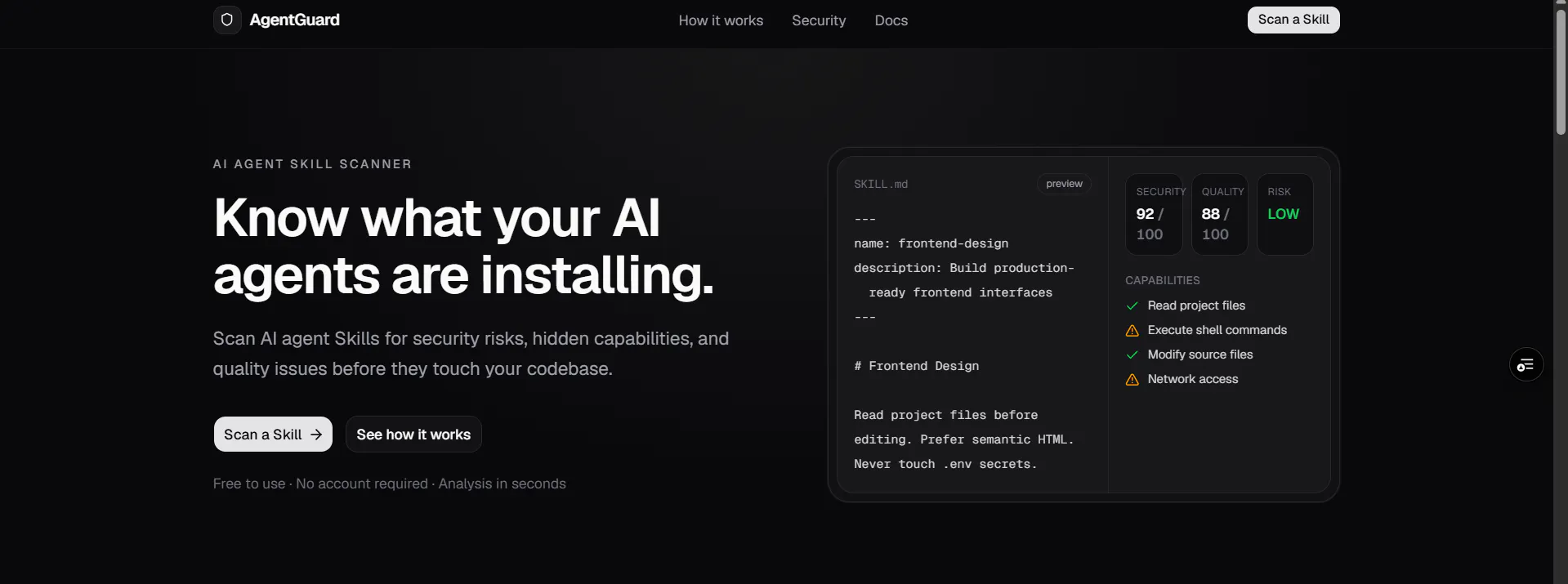
- Definition: AgentGuard is a specialized AI agent security scanner and static analysis tool designed for the AI agent ecosystem. It functions as a pre-installation vetting service for AI agent "Skills"—modular instruction sets, typically defined in
SKILL.mdfiles, that extend an agent's capabilities. - Core Value Proposition: AgentGuard exists to mitigate the significant security and operational risks of installing untrusted AI agent Skills. Its core value is providing immediate, automated AI agent security analysis, Skill vetting, and trust assessment before a Skill can interact with a user's system, codebase, or data. It addresses the critical need for AI supply chain security at the Skill level.
Main Features
- Automated SKILL.md Security Scanning: The tool performs a comprehensive static analysis on pasted Skill code. It uses deterministic pattern matching to identify high-risk instructions like shell command execution (
bash,curl), filesystem access patterns (read/write/delete), environment variable usage, and network request calls. This provides a fast, rule-based first layer of security screening. - AI-Assisted Behavioral & Intent Analysis: Beyond pattern matching, AgentGuard employs AI models to conduct semantic analysis. This detects more subtle risks like obfuscated instructions, potential prompt injection vectors, hidden capabilities not explicitly stated, and dangerous or destructive operational logic that might be context-dependent.
- Actionable Trust Report with Quantified Scores: The analysis culminates in a detailed Trust Report. This report provides quantified scores (e.g., Security: 92/100, Quality: 88/100), a clear overall risk verdict (LOW, MEDIUM, HIGH), and a breakdown of detected capabilities. Each finding includes a plain-English explanation of "Why this matters" and a practical recommendation, transforming raw analysis into an actionable security decision.
Problems Solved
- Pain Point: The "black box" problem of AI agent Skills. Developers and teams blindly install community-shared Skills, granting them extensive system permissions without understanding their true capabilities, leading to potential data leaks, system compromise, or malicious behavior.
- Target Audience: Primary users include AI Agent Developers integrating third-party Skills, DevSecOps Engineers responsible for securing AI toolchains, Enterprise AI Teams enforcing governance policies, and Security Researchers analyzing the AI agent ecosystem. Secondary users are Technical Product Managers overseeing AI agent deployments.
- Use Cases: Essential for vetting Skills from public marketplaces before internal use; integrating a security gate in a CI/CD pipeline for AI agent deployment; conducting due diligence on Skills for compliance (SOC2, ISO27001); and educating teams on secure Skill development practices by analyzing real examples.
Unique Advantages
Strengths & Limitations (Pros & Cons):
- Pros: Zero-friction access (no account, free tier) lowers the barrier to initial security checks. Fast analysis (seconds) enables quick vetting workflows. Clear, educational output (Trust Report) helps non-security experts understand risks. Focuses on the critical pre-installation phase, preventing issues before they occur.
- Cons: As a static analysis tool, it cannot detect runtime-only vulnerabilities or dynamic threats that manifest under specific agent states. Its effectiveness is limited to the provided
SKILL.mdtext (max 80,000 chars) and cannot analyze compiled code or binary dependencies a Skill might call. The AI-assisted analysis may have false positives/negatives inherent to model-based reasoning.
Key Alternatives & Differentiation:
- Manual Code Review: The traditional alternative. AgentGuard differentiates by providing automated, consistent, and instantaneous analysis versus time-consuming, error-prone human review. It codifies security knowledge for scale.
- General SAST/DAST Tools (e.g., Snyk, Checkmarx): These are designed for traditional software (web apps, containers). AgentGuard is specialized for the AI agent Skill paradigm, understanding Skill-specific syntax, agent instruction patterns, and the unique threat model of LLM-powered tools, which general tools miss.
- Competitor: "Skill Scanners" within Agent Platforms (e.g., OpenAI's GPT Store review): These are often opaque, platform-locked, and post-installation. AgentGuard is platform-agnostic (works on any
SKILL.md), provides transparent reporting, and operates pre-installation, giving control back to the user.
Frequently Asked Questions (FAQ)
- Does AgentGuard guarantee a Skill is 100% safe? No, AgentGuard does not guarantee absolute safety. It is a risk assessment and analysis tool that identifies known patterns and potential issues through static and AI-assisted analysis. It significantly reduces risk but cannot eliminate all possible runtime or zero-day vulnerabilities. A final security review is always recommended.
- What AI agents and Skill formats does AgentGuard support? AgentGuard primarily supports the
SKILL.mdfile format, a common standard for defining AI agent capabilities. It is agent-agnostic, meaning it can analyze Skills intended for platforms like OpenAI's GPTs, Claude's Artifacts, CrewAI, AutoGen, and any other agent framework that uses similar markdown-based instruction sets. - Is AgentGuard really free, and what are the limitations? Yes, the core scanning functionality is currently free to use with no account required, as stated. The main limitation is the input size cap of 80,000 characters per Skill scan. For sustained, high-volume enterprise use, future premium tiers offering API access, batch scanning, or integration features may be introduced.
- How does AgentGuard's analysis differ from just reading the SKILL.md myself? AgentGuard combines automated deep pattern recognition and AI-powered semantic analysis that can uncover hidden, obfuscated, or implied capabilities a human might miss. It provides consistent, quantified scoring against a defined security model, removing subjective bias and ensuring all Skills are evaluated against the same criteria.
- Can I integrate AgentGuard into my development or deployment pipeline? While the current web interface is for manual review, the concept is inherently pipeline-friendly. For automated workflows, one would look for or build a similar tool as a CI/CD pipeline gate (e.g., a GitHub Action) that fails a build if a Skill's risk score exceeds a threshold, enforcing security policy automatically.


