
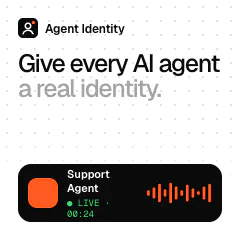
Product Introduction
- Definition: Agent Identity is a developer-first identity and access management (IAM) platform specifically engineered for AI agents and autonomous systems. It provides a unified SDK that assigns persistent, verifiable identities to AI agents, enabling secure, auditable interactions with APIs, databases, SaaS tools, and other agents.
- Core Value Proposition: It exists to solve the critical security and operational gap in agentic AI development. Traditional identity infrastructure was built for human users, not autonomous AI agents. Agent Identity provides the essential primitives—credentials, permissions, audit logs, and communication channels—so developers can safely deploy production-grade AI agents that interact with the real world.
Main Features
- Unified Agent Identity: Each AI agent receives a persistent, unique identity (e.g.,
agt_9kQm). This single identity consolidates multiple channels and permissions. It includes a dedicated email inbox, a programmable phone number for SMS/voice, a scoped secrets vault, and a signed public webhook endpoint. All these resources are tied to one agent, simplifying management and audit trails. - Secure Secrets Vault with Scoped Access: The platform provides an AES-256 encrypted vault for API keys and sensitive data. Crucially, it implements secret scoping, meaning each agent's identity only has access to its own explicitly granted secrets. Secrets are injected at runtime and never exposed to the AI model's prompt, mitigating leakage risks.
- Policy-Based Access Control & Audit Engine: Every action an agent attempts (send email, read vault, call API) is checked against a centrally defined policy before execution. This "checked before it runs" model allows fine-grained capability management (e.g., Support agents can read emails but Sales agents cannot). Every decision, allowed or blocked, is logged to a immutable audit trail.
- Multi-Channel Communication Hub: Agents are equipped with real communication tools: a professional email inbox for sending/receiving/threading, a Twilio-powered phone number for interactive SMS and voice calls, and verified webhook endpoints. All interactions across different channels (email, SMS, call) for a single user conversation are unified into one coherent thread.
- Agent-to-Agent (A2A) Network: The platform facilitates secure, verifiable communication between different AI agent identities using a signed messaging protocol. Agents can discover, authenticate, and delegate tasks to each other (e.g., a Research agent sending signed leads to a Sales agent), enabling complex, multi-agent workflows.
- Full Observability & Typed SDK: Developers get real-time observability into all agent activity, including live streams of events, request latency metrics, and active agent counts. The SDK is fully typed (TypeScript/Python), providing autocomplete for all events (
email.received,sms.received,call.completed,a2a.message) and reducing integration errors.
Problems Solved
- Pain Point: Lack of Agent-Centric Identity. AI agents lack a persistent, accountable identity when accessing external services, leading to security risks, impossible auditing, and chaotic permission sprawl using shared API keys.
- Pain Point: Insecure Secret Management for AI. Hard-coding or passing API keys through prompts is a major security vulnerability. Developers need a way to securely provide agents with credentials without exposing them to the AI model.
- Target Audience: AI/ML Engineers and Backend Developers building production, agentic AI systems that require real-world interaction. DevOps/Security Engineers needing to enforce compliance and audit trails for autonomous systems. Startups and Enterprises implementing customer support, sales, or research agents that use email, phone, and multiple SaaS integrations.
- Use Cases: Deploying a customer support AI agent that can securely access order databases (via scoped secrets), communicate via email and SMS (unified thread), and escalate to a human or another agent (via A2A). Building a sales research agent that can scour the web, store findings, and securely pass qualified leads to a sales outreach agent. Creating an internal operations agent with strict, audited permissions to perform automated tasks in GitHub, Linear, and Stripe.
Unique Advantages
- Differentiation: Unlike generic IAM (e.g., Okta) or basic secret managers (e.g., Vault), Agent Identity is purpose-built for the autonomous agent paradigm. It bundles identity, communications, secrets, and policy into one SDK, whereas competitors require stitching together multiple disparate services. Unlike using Twilio or Resend directly, it provides agent-scoped resources and a central audit layer.
- Key Innovation: The concept of a "Unified Identity" that spans both authentication and communication channels. An agent's identity is not just a key; it's an inbox, a phone number, a vault scope, and a policy profile all in one. The "checked before it runs" policy engine is central to safe agentic systems, moving authorization from an afterthought to a foundational primitive.
Frequently Asked Questions (FAQ)
- What is Agent Identity used for? Agent Identity is used to securely manage, control, and audit AI agents in production. It gives each autonomous AI agent its own persistent identity, secure credentials, communication channels (email, SMS), and permissions, enabling developers to build agents that safely interact with APIs and users.
- How does Agent Identity handle API keys and secrets securely? It uses a scoped, AES-256 encrypted vault. Secrets are stored encrypted at rest and are only injected into the agent's runtime environment when needed for a specific, policy-allowed action. They are never included in the AI model's prompt or context window, preventing accidental exposure.
- Can I self-host Agent Identity? Yes, Agent Identity is designed for both hosted (SaaS) and self-hosted deployments. You can run it on your own infrastructure using Docker, Kubernetes, or on any cloud platform (AWS, GCP, Azure, Vercel), maintaining full control over your data and compliance.
- What is the Agent-to-Agent (A2A) feature? A2A is a protocol within Agent Identity that allows different AI agents with verified identities to discover, authenticate, and send signed messages to each other. This enables secure delegation and coordination in multi-agent systems, such as a research agent passing tasks to a sales agent.
- How does the access control policy work? Developers define capabilities (e.g.,
sendEmail,accessVault) and assign them to agent identities. Before any agent action executes, the policy engine intercepts the request, checks the agent's identity against the policy rules, and either allows or blocks the action. All decisions are logged for full auditability.


