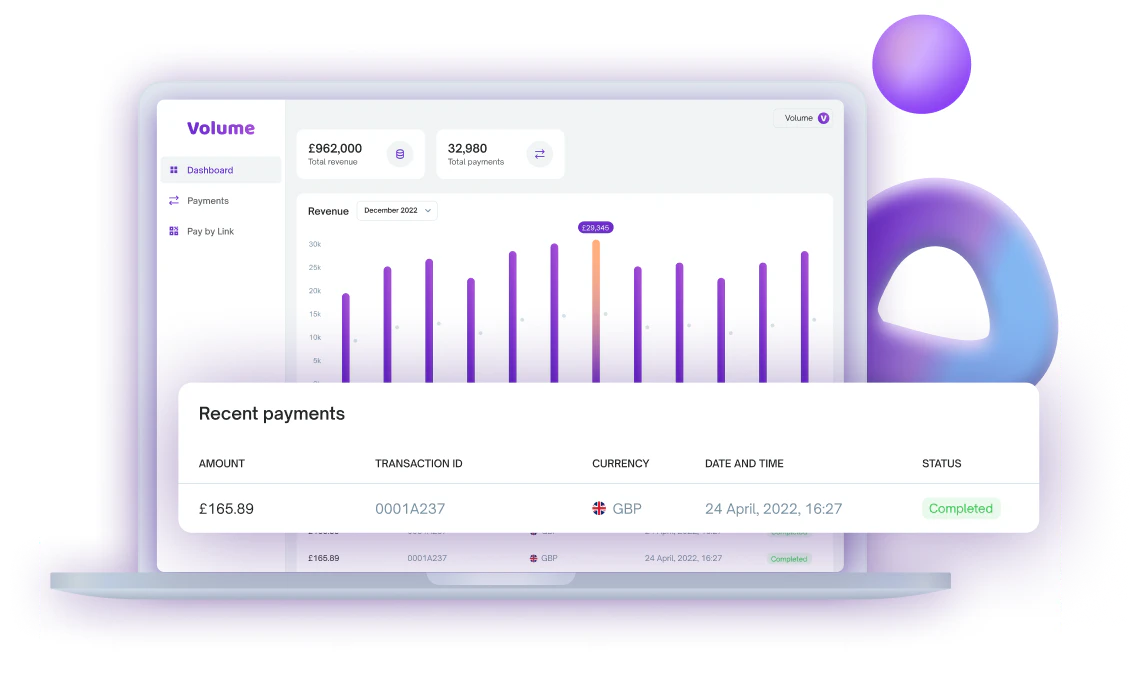
Product Introduction
- Definition: Volume is an open banking payment orchestration platform for business operators. Technically, it is a payment service provider (PSP) and financial operations platform that leverages account-to-account (A2A) payments, dedicated virtual accounts, and a proprietary API suite to facilitate instant bank-based checkouts and automated financial reconciliation.
- Core Value Proposition: Volume exists to replace traditional card processing for merchants by cutting payment friction, dramatically lowering transaction fees, eliminating chargeback risk, and providing instant settlement. Its primary value is enabling faster checkout conversions, near-zero payment fees, and real-time financial visibility through a unified system.
Main Features
- Volume Collect (Open Banking Checkout): This is the core payment initiation service. It works by presenting a customer with a list of their detected banks during checkout. The customer selects their bank, authenticates the payment using biometrics within their own banking app (via PIS - Payment Initiation Service), and the funds are transferred directly from their account to the merchant's dedicated Volume virtual account. This process uses local payment rails like Open Banking in the UK and SEPA in Europe, bypassing card networks entirely. It supports web, mobile, QR codes, payment links, and embedded SDKs for omnichannel deployment.
- Dedicated Virtual Accounts: Volume provides merchants with dedicated virtual IBAN accounts in GBP and EUR. These accounts, safeguarded by FCA-authorised EMI partners like Modulr FS Limited, act as the central hub for all collection, holding, and settlement activities. Funds from customer payments land here instantly, separating merchant funds from operational funds and providing a clear audit trail.
- Volume Reconcile (Financial Operations Dashboard): This is a unified reporting and reconciliation portal with a full REST API. It consolidates all payment activity—collections, refunds, payouts—across all Volume products into a single real-time dashboard. It provides automated transaction matching, role-based access controls, scheduled report exports, and webhooks with guaranteed delivery for triggering automated back-office workflows, eliminating manual reconciliation across multiple providers.
Problems Solved
- Pain Point: High costs and operational inefficiency of card payments. Traditional card processors charge 0.5–1% (or more) per transaction, impose settlement delays of 1-2 business days (T+1/T+2), and expose merchants to chargeback fraud rates of 0.5–1.5%, which require manual dispute management.
- Target Audience: The primary user personas are SaaS platforms, marketplaces, financial technology operators, and high-volume e-commerce merchants—specifically business operators, finance teams, and developers who manage payment flows and liquidity. These are businesses for whom payment fees, settlement speed, and reconciliation overhead significantly impact unit economics and operational bandwidth.
- Use Cases: Essential for businesses looking to: 1) Reduce payment processing costs by switching from cards to bank rails; 2) Improve cash flow by accessing funds in seconds instead of days; 3) Automate back-office reconciliation for finance teams drowning in spreadsheets from multiple payment providers; 4) Deploy a resilient payment system with redundant collection infrastructure across banking partners to prevent downtime from bank freezes.
Unique Advantages
- Differentiation: Unlike traditional PSPs or card processors (e.g., Stripe, Adyen for cards), Volume does not route payments through card networks. It directly connects customer bank accounts to merchant virtual accounts via open banking. This results in fundamentally lower costs (~0% vs. 0.5-1%), instant settlement (seconds vs. days), and the near-elimination of chargebacks because each payment is biometrically authenticated by the bank.
- Key Innovation: The combination of proprietary smart bank detection (which reduces checkout to one tap), collection redundancy (auto-failover across multiple banking partners like HSBC, Barclays), and a fully integrated virtual account system within a single API. This creates a closed-loop "operating system" where payment collection, holding, and reporting are natively unified, unlike patchwork solutions that bolt open banking onto legacy settlement systems.
Frequently Asked Questions (FAQ)
- How does Volume's pricing compare to Stripe or other card processors? Volume Collect typically charges significantly lower fees than card processors because it uses direct bank rails instead of card networks. While card processors often charge 0.5-1% + a fixed fee per transaction, Volume's model is based on account-to-account payments, which can reduce this cost to near-zero, with settlement in seconds and no chargeback fees.
- Is Volume secure and compliant for handling business payments? Yes, Volume is fully compliant. It operates as a distributor of FCA-authorised Electronic Money Institutions (EMIs) like Modulr FS Limited. Client funds are held in segregated, safeguarded accounts in accordance with the Electronic Money Regulations 2011. All open banking payments are authenticated by the customer's own bank using biometric security.
- What countries and currencies does Volume support for pay-ins? Volume Collect supports pay-ins via open banking and local rails in the United Kingdom (GBP), Germany, France, Spain, Netherlands, Belgium, Italy, Ireland, Austria, and Portugal (EUR). Support for Canada and Australia is listed as coming soon.
- Can I use Volume alongside my existing payment gateway? Yes, Volume is designed to work alongside existing providers. However, the platform notes that most business operators eventually replace their card processor entirely after integrating Volume Collect due to the combined benefits of lower costs and higher checkout conversion rates.
- How long does integration take for a development team? Integration is designed for speed. Using Volume's SDKs for iOS, Android, and Web, or no-code payment links, most business operators can go live in days rather than months. The core checkout integration is cited as requiring approximately five lines of code.