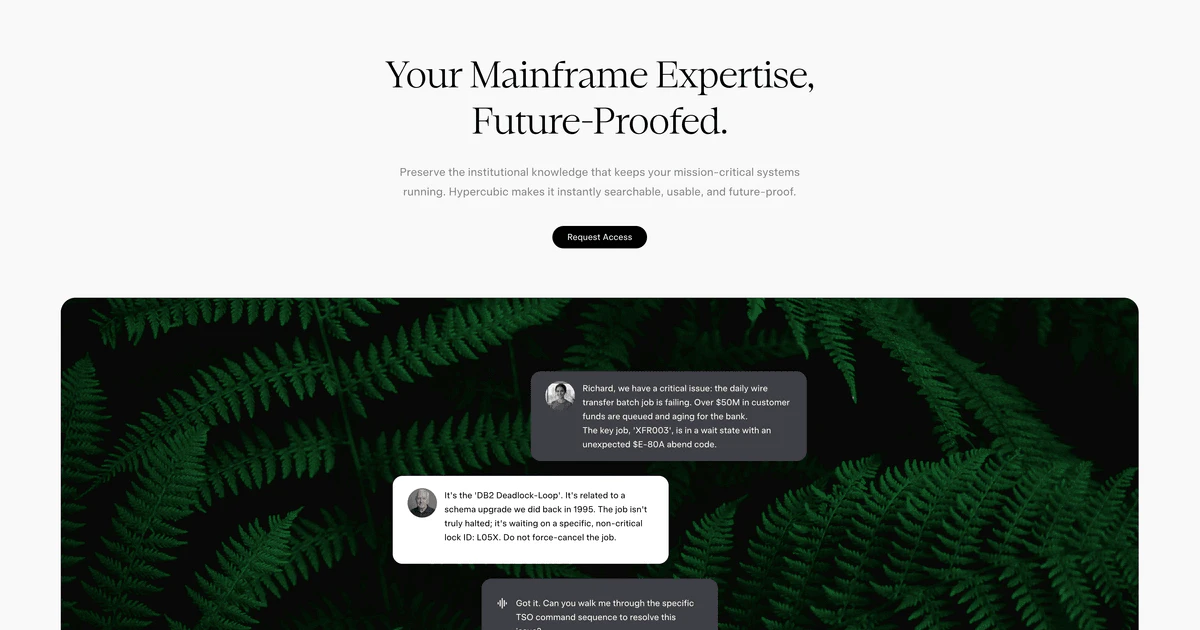
Product Introduction
Definition: Hypercubic.ai is an enterprise-grade, industrial-scale AI platform specifically engineered for mainframe modernization and legacy system transformation. It functions as an end-to-end ecosystem designed to bridge the gap between mission-critical COBOL-based infrastructure and modern cloud-native architectures through agentic AI and automated logic extraction.
Core Value Proposition: Hypercubic exists to de-risk the transition from legacy mainframes to modern systems by preserving "tribal knowledge"—the undocumented expertise of veteran engineers. By leveraging AI-powered business logic extraction and documentation, the platform ensures the continuity of the world’s most critical infrastructure, including systems for global finance, government operations, and defense. It targets the "silver tsunami" of retiring mainframe experts, ensuring their technical insights remain accessible for future system maintenance and migration.
Main Features
HyperLoop (Modernization Engine): This high-velocity modernization engine is designed to re-engineer legacy mainframe systems into modern, scalable architectures. Instead of traditional "lift and shift" methods, HyperLoop analyzes complex COBOL structures and rewrites them into modern languages and frameworks in a fraction of the time typically required. It uses proprietary AI models to ensure that the original business intent and logic are maintained while optimizing for modern cloud environments.
Hopper (Agentic Mainframe Terminal): Hopper is the industry’s first agentic terminal for mainframes, providing a natural language interface for legacy environments. It allows system operators to interact with z/OS or TPF environments using plain English rather than complex command-line syntax. Hopper automates mission-critical workflows and system operations at scale, enabling junior developers to manage mainframe environments with the efficiency of experienced sysadmins.
HyperDocs (Automated Logic Documentation): HyperDocs transforms opaque and undocumented COBOL codebases into "living," searchable documentation. Using deep code analysis, it maps out dependencies, data flows, and hidden business rules within legacy systems. This feature ensures that mission-critical logic is visible and understandable to stakeholders across the organization, preventing the loss of institutional knowledge during personnel transitions.
HyperTwin (Expertise Capture System): HyperTwin captures the diagnostic patterns and debugging methodologies of top-tier mainframe engineers. By observing how experts interact with and fix legacy systems, HyperTwin creates a digital model of their expertise. This allows the platform to provide 24/7 expert-level troubleshooting guidance to the entire engineering team, significantly reducing Mean Time to Repair (MTTR) for critical outages.
Problems Solved
Pain Point: Loss of Tacit Knowledge. Many enterprises rely on systems written decades ago by engineers who are now retiring. When these experts leave, the "why" behind the code is lost. Hypercubic solves this by capturing tacit knowledge before it disappears, transforming it into documented, actionable insights.
Target Audience: The platform is built for Enterprise Architects, Chief Technology Officers (CTOs), Mainframe Modernization Leaders, and System Operations (SysOps) teams within highly regulated industries such as Financial Services (BFSI), Insurance, Healthcare, Defense, and Government.
Use Cases:
- Financial Services: Modernizing core banking systems that handle trillions in daily transactions without interrupting service.
- Government: Documenting and updating citizen-facing infrastructure on z/OS to meet modern security and accessibility standards.
- Airlines: Migrating high-volume reservation and operational systems from TPF to cloud-native microservices.
- Telecommunications: Extracting billing and network control logic from legacy COBOL to implement modern, agile billing solutions.
Unique Advantages
Differentiation: Unlike traditional consulting-led migrations or generic code conversion tools, Hypercubic focuses on the "Logic Layer." Most competitors focus on syntax translation; Hypercubic focuses on understanding and replicating the original intent of the system, which fundamentally de-risks the modernization process.
Key Innovation: The platform’s specific focus on "Agentic AI" for mainframes. By creating a faithful, explorative environment where AI can interact directly with legacy logic, Hypercubic avoids the pitfalls of "flattening" complex systems into static documentation. Its ability to create "Digital Twins" of human expertise represents a paradigm shift in how legacy systems are maintained and evolved.
Frequently Asked Questions (FAQ)
How does Hypercubic.ai help with COBOL logic extraction? Hypercubic uses its HyperDocs and HyperLoop modules to analyze legacy COBOL repositories. It identifies core business rules, data dependencies, and logical branches, then translates this information into human-readable documentation and modern code structures. This process automates the discovery phase of modernization, which is typically the most time-consuming part of legacy migration.
Can Hypercubic modernize mainframes without causing system downtime? Yes. Hypercubic is designed for critical infrastructure where downtime is not an option. By using its HyperTwin and Hopper modules, teams can gain deep visibility into their systems and automate workflows in parallel with existing operations. The transition to modern architecture via HyperLoop is phased, allowing for rigorous testing and validation before any mission-critical systems are switched over.
Why is "Tribal Knowledge Preservation" important for mainframe modernization? Most mainframes lack updated documentation, meaning the only people who understand how the systems work are the senior engineers who built them. As these individuals retire, the organization faces a "Board-level risk." Hypercubic preserves this expertise digitally, ensuring that the logic governing trillions of dollars in transactions or essential government services remains accessible and maintainable by the next generation of engineers.