Product Introduction
- Definition: HackerPulse is a specialized AI impact measurement and engineering analytics platform. It falls into the technical categories of Engineering Productivity (EngProd) software, Developer Tool Analytics, and AI Operations (AIOps) for software development.
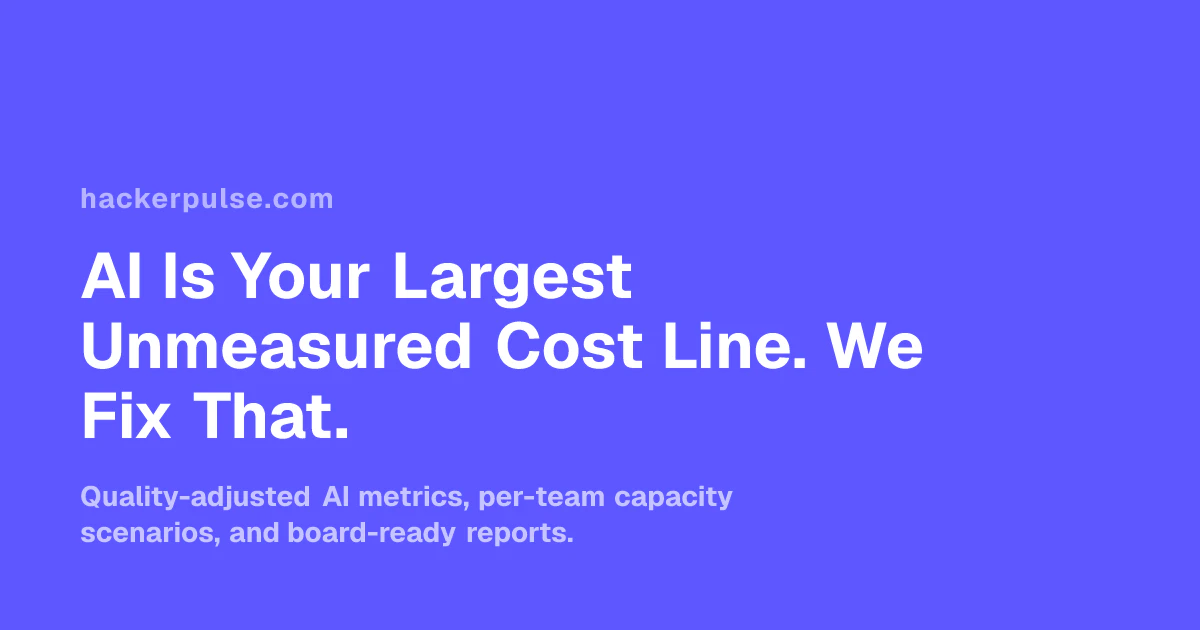
- Core Value Proposition: HackerPulse exists to quantify the true return on investment (ROI) and business impact of AI coding assistants (like GitHub Copilot, Cursor, etc.) on engineering teams. It transforms raw AI adoption data into quality-adjusted AI metrics, capacity scenarios, and board-ready reporting, moving beyond vanity metrics to measure actual engineering output and efficiency gains.
Main Features
- Quality-Adjusted AI Metrics Dashboard: This is the core analytical engine. HackerPulse integrates with existing development tools (version control like Git, project management like Jira, code review platforms) to compute five key metrics. It works by attributing code changes to AI-assisted work and then analyzing the quality and efficiency of that output. The specific metrics are AI Attribution (percentage of work involving AI), Acceptance Quality (merge/pass rate of AI-touched code), Review Tax (additional time reviewers spend on AI-generated code), Rework Rate (frequency of post-merge revisions), and Defect Rate (bugs linked to AI-assisted work).
- Per-Team Capacity Scenario Modeling: This feature provides defensible forecasting for engineering leadership. Instead of providing a single, unreliable org-wide average, HackerPulse analyzes metrics at the team level (e.g., Platform, Mobile, Data) to generate ranged capacity projections (e.g., "+15–20% capacity absorbed"). It works by correlating AI quality metrics with historical velocity and workload data to model how AI efficiency translates into concrete headcount planning and hiring scenarios for board-level discussions.
- Evidence-Backed Performance Evaluation for Engineers: This feature shifts performance management for the AI era. It creates individual contributor reports that answer "how well does this engineer use AI to produce better outcomes?" rather than just raw output. It works by aggregating an engineer's AI-Assisted Contribution data (PRs with AI attribution, acceptance quality, rework rate) alongside their traditional contribution metrics (total PRs, cycle time), providing managers with data-driven insights for fair and accurate performance reviews.
Problems Solved
- Pain Point: The "AI Measurement Gap." Engineering leaders have widespread AI adoption but lack a framework to prove if it increases velocity or just creates more technical debt and review overhead. This leads to an inability to justify AI spend, plan headcount, or report credible ROI to the board.
- Target Audience: Primarily engineering leadership and technology executives: VPs of Engineering, CTOs, Directors of Engineering, and Engineering Managers at software companies where AI coding tools are in use. Secondary users include Technical Program Managers and Business Operations roles tasked with quantifying engineering productivity.
- Use Cases: Essential for: 1) Preparing a data-driven board report on AI tool ROI and its impact on hiring plans. 2) Identifying which engineering teams are using AI effectively versus those where it's creating hidden "review tax." 3) Conducting fair performance reviews for engineers in an AI-assisted workflow. 4) Running capacity planning exercises to determine if AI gains allow for redeployment of resources or a reduction in planned hires.
Unique Advantages
- Differentiation: Unlike generic engineering dashboards or AI adoption trackers that only measure usage, HackerPulse focuses exclusively on quality-adjusted output. It differentiates by measuring the often-hidden costs of AI (review tax, rework) and tying activity directly to business-ready capacity scenarios, whereas competitors may only show activity volume or simple velocity changes.
- Key Innovation: The platform's core innovation is its "AI Maturity Levels" framework and the associated five quality-adjusted metrics. This provides a standardized, computable model for assessing where a team is on the spectrum from mere AI adoption to genuine AI-driven impact, turning a qualitative challenge into a quantitative analysis.
Frequently Asked Questions (FAQ)
- How does HackerPulse measure AI impact on engineering teams? HackerPulse measures AI impact by integrating with your existing development toolchain (Git, JIRA, etc.) to compute five quality-adjusted metrics: AI Attribution, Acceptance Quality, Review Tax, Rework Rate, and Defect Rate. It moves beyond simple adoption metrics to analyze the actual efficiency and output quality of AI-generated code.
- What is "review tax" in the context of AI coding assistants? Review tax, as defined and measured by HackerPulse, is the additional time code reviewers spend inspecting, correcting, and providing feedback on AI-generated code compared to human-written code. It's a key hidden cost of AI adoption that can negate productivity gains if not measured and managed.
- Is HackerPulse compatible with GitHub Copilot and other AI coding tools? Yes, HackerPulse is tool-agnostic. It works by analyzing the code output and development activity in your version control and project management systems. It does not need direct integration with the AI tool itself; it measures the results of using tools like GitHub Copilot, Cursor, Amazon CodeWhisperer, or others in the production workflow.
- How does HackerPulse help with engineering headcount planning? HackerPulse aids headcount planning by generating per-team capacity scenarios based on AI efficiency data. By showing how much productive capacity AI is absorbing (e.g., +15-20%), it provides defensible, data-backed ranges for justifying, delaying, or re-allocating engineering hires in conversations with finance and the board.
- What security standards does HackerPulse comply with? HackerPulse is built with enterprise-grade security, holding SOC 2 Type II compliance and adhering to GDPR data protection standards. Customer data is encrypted, audited, and is never used to train AI models.