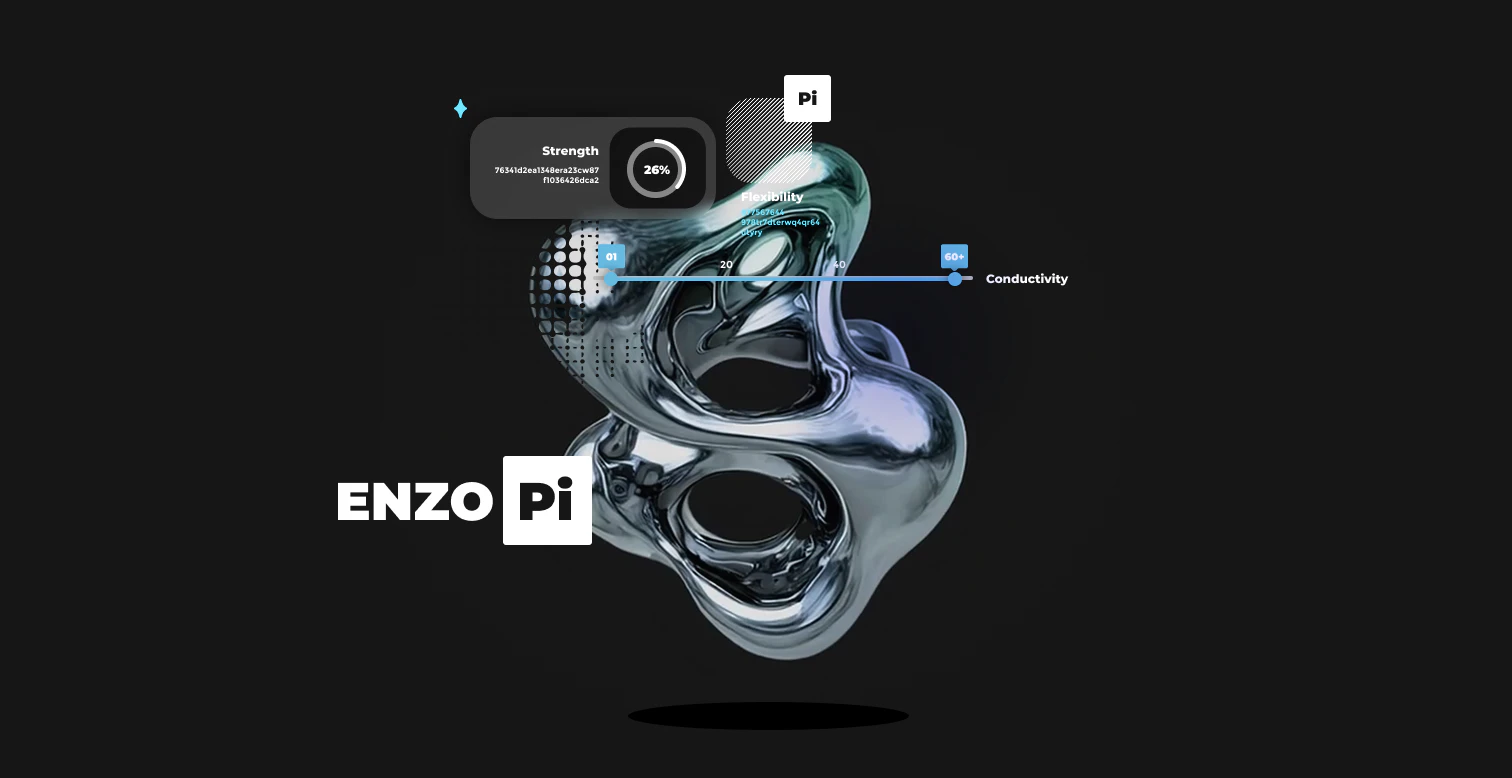
Product Introduction
Definition: EnzoPi is a next-generation software-driven manufacturing platform and material compiler designed for the fabrication of programmable materials. It operates at the intersection of advanced material science and industrial automation, enabling the creation of "programmable matter" with highly specific, engineered structures, densities, and performance characteristics at an industrial scale.
Core Value Proposition: EnzoPi exists to bridge the gap between digital design and physical material reality, solving the limitations of traditional manufacturing where material properties remain static and non-programmable. By utilizing a "Prompt-to-Physical Material" workflow, the platform enables rapid iteration, localized production, and the development of materials with multiple, often conflicting properties (e.g., high strength vs. low weight). Its primary keywords include programmable materials, material compiler technology, advanced manufacturing scale, and closed-loop material design.
Main Features
Material Compiler Technology: This core software engine functions as a bridge between functional requirements and physical material properties. It translates complex engineering specifications into precise manufacturing instructions, allowing designers to manipulate material architectures at the micro-scale. This enables a "closed-loop" manufacturing process where materials are designed and fabricated in real-time based on specific performance data.
Micro-Scale Manipulation & Density Tuning: The EnzoPi platform allows for granular control over the internal structure of materials, including density and porosity tuning. By manipulating materials at the micro-level, the platform can create new isotropic (uniform properties in all directions) and anisotropic (directionally dependent properties) materials. This level of control is critical for engineering specialized performance characteristics like vibration damping or specific thermal gradients.
Multi-Degree of Freedom (MDF) Fabrication: EnzoPi’s hardware utilizes multiple degrees of freedom to overcome the limitations of traditional layering. This is particularly evident in its ability to deliver superior Z-axis strength, which is often a failure point in standard additive manufacturing. This capability is essential for structurally critical components in aerospace and defense, such as missile casings and drone frames.
Engineered Anisotropy: The platform can generate materials with engineered composition and performance by controlling the orientation and distribution of fibers or particles within a matrix. This allows for the creation of components that are 50–80% lighter than traditional metals while maintaining or exceeding their mechanical strength.
Problems Solved
Pain Point: Static Material Functionality: Traditional manufacturing often relies on a "one-material-one-property" paradigm. EnzoPi addresses the "unpredictable material interaction" problem by allowing for multi-functional materials that can handle heat, impact, and structural load simultaneously within a single integrated system.
Target Audience: The platform is engineered for high-stakes industries including Defense Prime Contractors, AI Infrastructure Architects, Aerospace Engineering firms, and Advanced Composite Manufacturers. It specifically serves Materials Scientists and R&D Engineers who require rapid prototyping without the high costs of traditional physical validation.
Use Cases:
- Defense: Development of "Self Armor" and structural components for missile and drone systems that require high Z-axis strength and resistance to extreme heat or vibration.
- AI & Data Center Cooling: Designing materials with embedded cooling channels and high thermal conductivity to increase compute density and reduce energy consumption in AI-scale data centers.
- Advanced Composites: Creating composite materials with integrated EMI shielding and reduced layer counts for faster industrial production.
- Advanced Alloys: Reducing processing complexity in alloy development by enabling engineered compositions that break traditional performance limits.
Unique Advantages
Differentiation: Unlike traditional manufacturing which is often slow and requires costly physical prototyping for every new formulation, EnzoPi offers a 500x faster production cycle. It challenges traditional subtractive and additive methods by reducing CAPEX (Capital Expenditure) by 80% and material waste by 95%, making localized, high-performance manufacturing economically viable.
Key Innovation: The "Prompt-to-Physical Material" capability represents a paradigm shift. By turning physical materials into "programmable systems," EnzoPi moves manufacturing away from "locked-out" creative processes toward an agile, software-defined model. Its ability to engineer performance at the fiber level allows for the creation of materials that are fundamentally smarter and more functional than those produced via traditional casting, milling, or standard 3D printing.
Frequently Asked Questions (FAQ)
What is EnzoPi's programmable matter technology? EnzoPi’s programmable matter is a material system where the physical structure and performance (such as density, strength, and thermal conductivity) are defined by software and fabricated with micro-scale precision. This allows for materials to be "programmed" to behave in specific ways under different environmental stresses.
How does EnzoPi accelerate the manufacturing process? EnzoPi utilizes a material compiler that eliminates the need for slow, iterative physical prototyping. By using a software-driven, closed-loop platform, the system can design and fabricate materials up to 500 times faster than traditional methods, significantly shortening the development cycle for new products.
Can EnzoPi materials replace traditional metals in defense applications? Yes, EnzoPi can engineer materials that are 50–80% lighter than traditional metals while providing superior Z-axis strength and tailored resistance to impact and heat. This makes it an ideal solution for weight-sensitive, high-performance applications like missiles, drones, and advanced armor systems.