Product Introduction
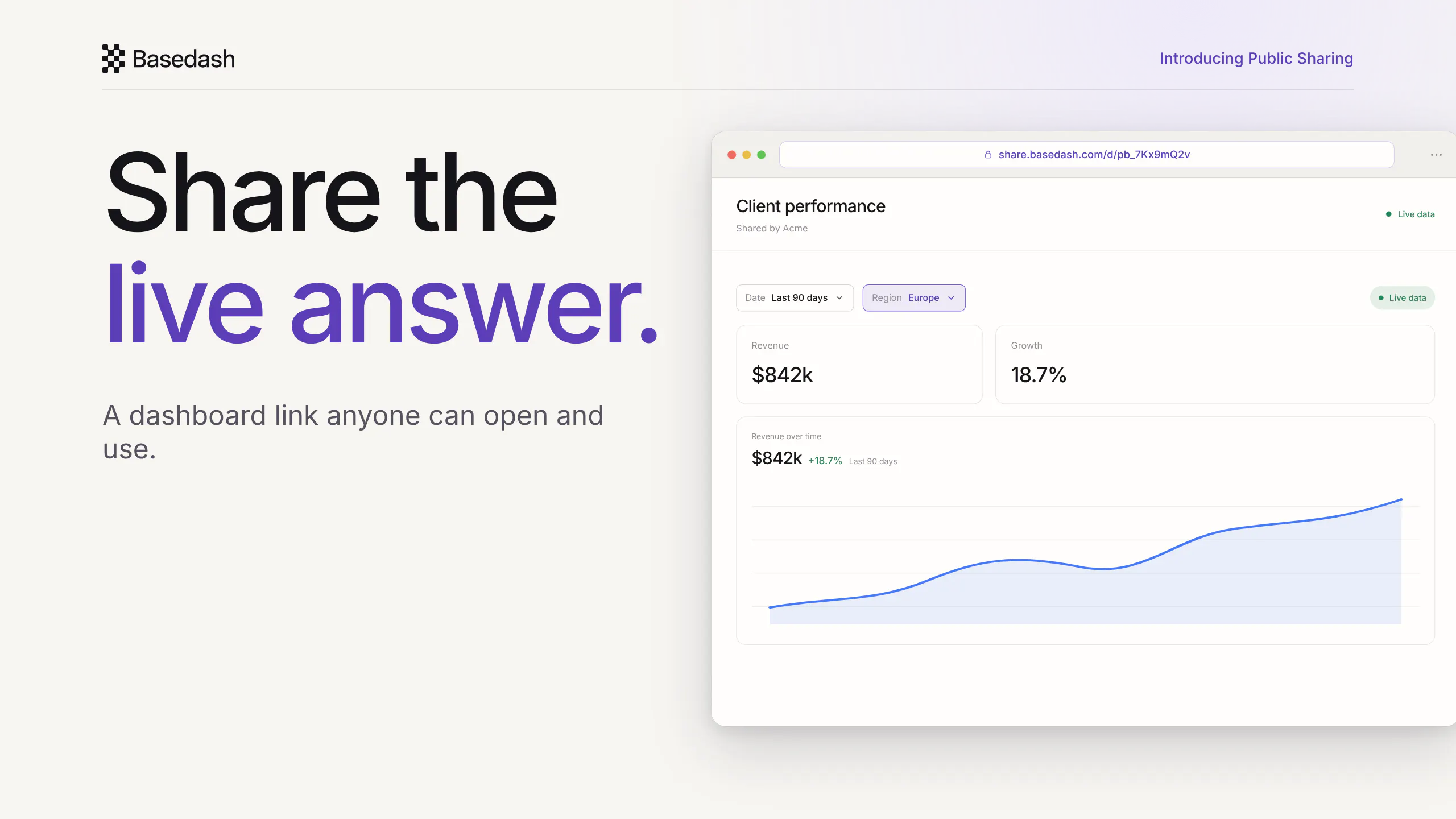
- Definition: Basedash Public Sharing is a tokenized link-sharing feature within the Basedash AI-native business intelligence (BI) platform. It allows users to generate secure, shareable URLs for live dashboards and individual charts.
- Core Value Proposition: It exists to eliminate the friction of sharing live business intelligence data with external stakeholders. The primary value is enabling secure, no-login, interactive data sharing without requiring recipients to have a Basedash account or be added as a paid seat, thereby streamlining client reporting, investor updates, and cross-company collaboration.
Main Features
- Tokenized Public Link Generation: Users can generate a unique, cryptographically secure URL token for any dashboard or individual chart. This token grants view-only access to the live data visualization without exposing the underlying Basedash workspace or requiring authentication. The link is designed to be difficult to guess but does not authenticate individual viewers.
- Interactive Viewer Experience: Unlike static screenshots or PDF exports, shared views remain fully interactive. Authorized viewers can utilize all embedded dashboard filters (including dynamic filters powered by SQL or record data), sort table columns, and rearrange data. Their interactions are session-based and do not alter the original dashboard configuration.
- Granular Sharing Controls: Sharing can be applied at two levels: the entire dashboard or a single chart. Chart-level sharing preserves any pre-applied filters, allowing users to share a focused, context-specific data slice without building a separate report. Access can be revoked instantly by toggling the public link "off" in the share settings.
Problems Solved
- Pain Point: The cumbersome process of onboarding external users (clients, investors, contractors) into a BI platform, which involves account creation, permission management, and potential per-seat costs. Alternatives like static exports (PDFs, screenshots) become outdated instantly and lack interactivity.
- Target Audience: Product managers sharing KPIs with leadership, SaaS account managers providing performance dashboards to clients, startup founders reporting metrics to investors or board members, and operations teams collaborating with external contractors or partners on data-driven projects.
- Use Cases: A SaaS company sharing a live customer success dashboard with a key enterprise client before a quarterly business review. A startup founder sending a live financial and growth metrics dashboard to potential investors during fundraising. A marketing team providing an interactive campaign performance report to an external agency partner.
Unique Advantages
- Differentiation: Unlike traditional BI tools that require full user provisioning for external sharing, Basedash Public Sharing uses a lightweight token model. Compared to embedding solutions (like Basedash's own Embedding feature), it requires zero code and is designed for direct link sharing via email or chat, not for integration into a customer-facing application.
- Key Innovation: The combination of a secure, token-based access system with a fully preserved interactive experience. It delivers the live, query-backed power of a full BI platform through a simple URL, maintaining filter logic and data freshness without compromising the security of the core workspace.
Frequently Asked Questions (FAQ)
- Is Basedash Public Sharing secure for sensitive data? Public Sharing is designed for controlled distribution of non-sensitive operational or reporting data. The tokenized link is hard to guess but does not authenticate individual users or replace row-level security. It is recommended to share only intended data views and disable links when no longer needed. For customer-facing analytics with user-specific data, Basedash Embedding with JWT authentication is the appropriate solution.
- Can viewers of a public link edit the dashboard or see my other data? No. Public Sharing provides a strictly view-only, isolated experience. Viewers cannot edit the dashboard, access the underlying Basedash workspace, navigate to other dashboards, or see any data not included in the specifically shared view and its configured filters.
- How does Basedash Public Sharing differ from embedding? Public Sharing generates a standalone URL for direct sharing via communication tools (email, Slack). Embedding involves integrating Basedash components via iframe and JavaScript into your own web application, typically for creating a customer-facing analytics portal with authenticated user access and row-level security.
- What happens to the public link if I update the original dashboard? The public link displays the live, current version of the dashboard or chart. Any changes you make to the underlying data, queries, or dashboard layout are reflected in the shared view the next time it is loaded, ensuring stakeholders always see the latest information.
- Is there a limit to how many people can use a public sharing link? No, there is no viewer limit. Anyone in possession of the active URL can access the shared view. Management is based on link control; you can distribute the link to your intended audience and revoke access universally by disabling the public link in your Basedash settings.