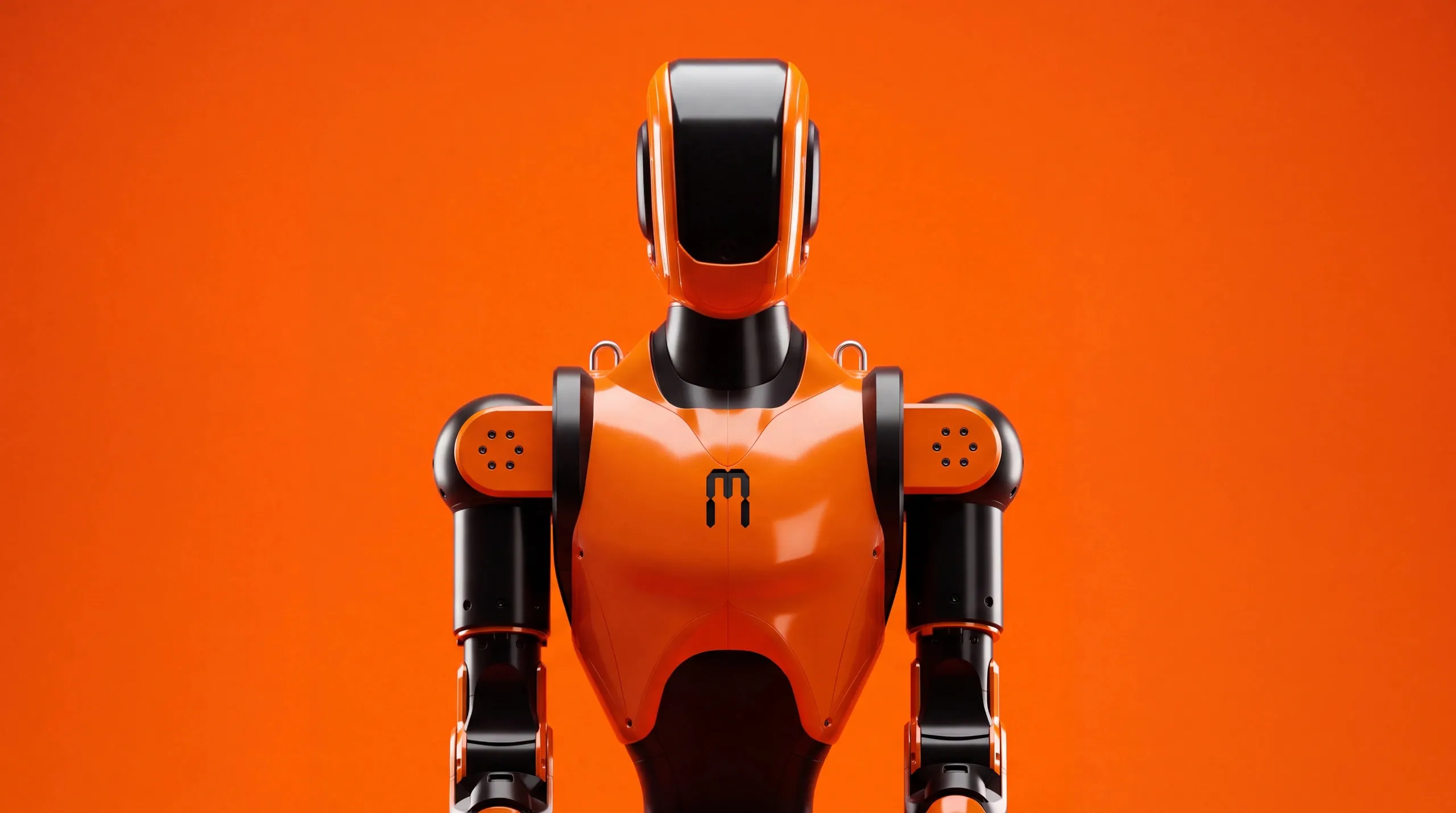
Product Introduction
- Definition: The Asimov 1 is a full-size, open-hardware humanoid robot platform designed for advanced robotics research, development, and commercial deployment. It falls into the technical category of a bipedal humanoid robot for whole-body control and locomotion.
- Core Value Proposition: Asimov 1 exists to provide a production-ready, developer-centric humanoid robot that bridges the gap between simulation and real-world hardware. Its primary value is enabling founders, researchers, and developers to rapidly test AI models, collect real-world sensor data, and deploy functional robotic applications without the prohibitive cost and complexity of building a platform from scratch.
Main Features
- Open Hardware & Bill of Materials (BOM): The complete mechanical design (CAD), electrical schematics, and bill of materials are published. This allows for full transparency, customization, and independent sourcing of parts. How it works: Developers can access the BOM to understand component costs, perform repairs with off-the-shelf parts, or modify the chassis and actuators for specific use cases.
- Sim-to-Real Ready Platform: The robot is built to run policies trained in simulation directly on physical hardware. How it works: It utilizes a standardized simulation stack (likely built on frameworks like Isaac Sim or MuJoCo) that accurately models the robot's dynamics, allowing for reinforcement learning and control algorithm development in a virtual environment before seamless deployment to the Asimov 1 unit.
- Developer-Focused Data & Control APIs: The system provides direct access to raw, unfiltered sensor data and real-time control interfaces. How it works: Through documented APIs, users can stream data from onboard cameras, inertial measurement units (IMUs), and joint encoders, and send low-level motor commands or high-level trajectory goals, enabling everything from teleoperation to autonomous agent testing.
Problems Solved
- Pain Point: The extreme barrier to entry for humanoid robotics R&D, where acquiring a reliable, full-stack platform for testing real-world AI and control policies has been cost-prohibitive and technically daunting for all but the largest institutions.
- Target Audience: Robotics researchers in academia and industry, AI/ML engineers specializing in embodied AI, startup founders building commercial robotic applications, and advanced developers in the humanoid robotics space.
- Use Cases: Training and validating reinforcement learning policies for bipedal locomotion; collecting proprietary datasets of real-world interactions for computer vision and manipulation models; conducting live technology demonstrations for investors or clients; serving as a standardized hardware platform for multi-robot research or commercial service applications.
Unique Advantages
Strengths & Limitations (Pros & Cons):
- Pros: Unprecedented transparency and repairability due to open-source hardware; significantly lower cost of entry compared to proprietary industrial humanoids; designed specifically for iterative software development and testing; global service network promises faster support.
- Cons: Requires significant technical expertise to assemble (DIY kit) and program effectively; as a new platform, the long-term reliability and proven durability in harsh environments are still being established; lacks advanced end-effectors (dexterous hands) in its base configuration, focusing instead on the core mobility platform.
Key Alternatives & Differentiation:
- Boston Dynamics Atlas: A vastly more advanced and dynamic robot, but it is a closed, proprietary research platform not available for commercial purchase or modification by external teams. Asimov 1 differentiates on openness, affordability, and developer access.
- Unitree H1: A competitor in the affordable, full-size humanoid category. Differentiation lies in Asimov 1's strong emphasis on open hardware, published BOM, and a workflow explicitly built around simulation-to-real transfer, positioning it more as a developer tool than a turnkey product.
- Building In-House: The alternative is to develop a custom humanoid, which involves years of mechanical, electrical, and software engineering. Asimov 1 provides a massive head start with a battle-tested platform, allowing teams to focus resources on their unique AI and application software.
Frequently Asked Questions (FAQ)
- What is included when you purchase an Asimov 1 humanoid robot? The purchase includes all necessary mechanical parts, actuators, sensors, and onboard computing hardware required to assemble a complete robot. It is sold primarily as a DIY kit with comprehensive assembly manuals. The published Bill of Materials (BOM) allows you to see every component.
- How does the sim-to-real workflow work with Asimov 1? Developers train their control policies and AI models in a provided or compatible simulation environment that uses an accurate digital twin of the Asimov 1. Once validated in simulation, the same software stack and policy can be deployed directly to the physical robot, drastically reducing real-world training time and risk of damage.
- What are the technical specifications for Asimov 1's sensors and compute? The robot features a suite of cameras and inertial sensors for perception and state estimation. The specific compute platform is designed to run modern machine learning models onboard, facilitating autonomous operation. For exact camera resolutions, IMU specs, and processor details, consult the official technical documentation.
- Can the Asimov 1 robot be used for commercial applications, not just research? Yes, the product is explicitly marketed as a platform to "build a company on." Its design for durability, repairability, and live demos, along with enterprise deployment by its creators, indicates it is engineered for commercial pilot projects and early-stage product deployment beyond pure research.
- What kind of support and warranty is provided for Asimov 1? Menlo Research operates a global network of service partners for assembly and repair. The open-hardware model empowers user repairability. Specific warranty terms for parts and labor should be confirmed at the time of purchase, as they are crucial for enterprise buyers.